
Mesquite borer
Placosternus difficilis

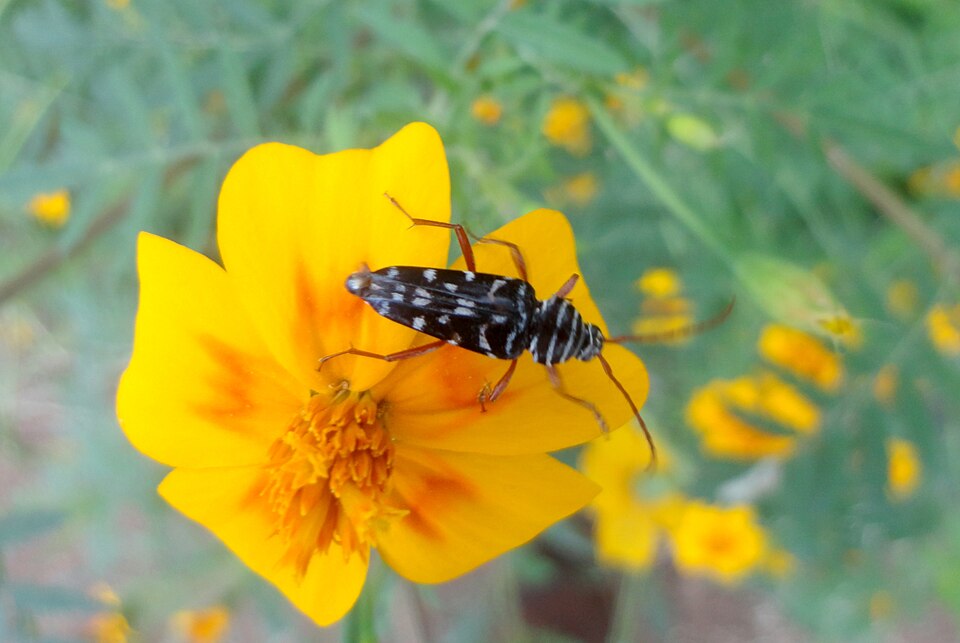
The mesquite borer is a longhorn beetle dressed up like a black and yellow wasp. Its babies grow up inside the wood of trees, especially mesquite trees. The grown-ups like to visit flowers.
Lives in
The south of the United States, Mexico, Honduras, Cuba and the Bahamas
Can it hurt you?
Harmless
Harmless. It only looks like a wasp and has no sting.
What does it eat?
The grown-ups drink nectar and eat pollen from flowers. The babies chew their way through wood.
How fast is it?
A garden snail about 0.05 km/h (0.03 mph)
A tortoise about 0.3 km/h (0.19 mph)
Mesquite borer about 0.4 km/h (0.25 mph)
A person walking about 5 km/h (3.1 mph)
cool stuff
Fun facts
1
Its black and yellow colours make it look like a wasp.
2
It is drawn to mesquite trees that have freshly cut or broken branches and logs.
3
Its babies can grow up in many kinds of trees, not only mesquite.
you asked
Most asked questions about Mesquite borer
?Is the mesquite borer a wasp?
No. It is a beetle that looks like a black and yellow wasp, and it has no sting.
?What does the mesquite borer eat?
The grown-ups eat nectar and pollen from flowers, and the babies feed inside wood.
For bug experts
- Scientific name
- Placosternus difficilis
- Group
- Beetles
- Family
- Cerambycidae
- Classification
- Insecta > Coleoptera > Cerambycidae
- Lives on
- North America
Where the facts come from
- Placosternus difficilis (Wikipedia, CC BY-SA 4.0): what it looks like, where it lives, what it eats, sizes and fun facts, retold in simple words.
- Picture by Juan Carlos Fonseca Mata. CC BY-SA 4.0, Wikimedia Commons. The sticker of this bug is drawn from this picture.
If we got something wrong, sorry, we are bug fans, not a science journal. Tell us at [email protected] and we will fix it.
Bug Wiki honey jar For grown-ups: Bug Wiki is free, with no ads and no tracking. A small tip helps keep it online.Leave a tip Stag beetle
 Hercules beetle
 Common glow-worm
 Goliath beetle
 Cockchafer
 Mealworm beetle
 Suffolk antlion
 Red-bellied jumping spider
 Western harvester ant
 Witchetty grub moth
 Black honeypot ant
 Egyptian giant camel spider
,_Mexico.jpg)