

Migrant hawker
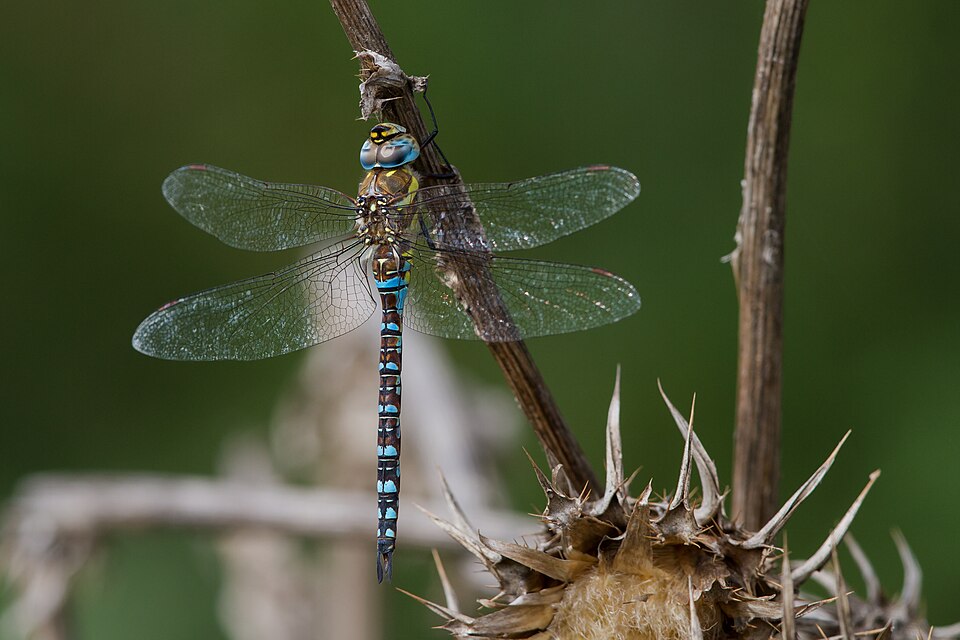
The migrant hawker is one of the smaller hawker dragonflies. The male has a dark body with blue spots and a little yellow mark shaped like a golf tee near the top of its tail. It flies late in the year, all through autumn.
How fast is it?
Fun facts
It is a traveller. It flew across to Britain from Europe and now lives in England, Wales and southern Scotland.
It reached the Isle of Man in 1998 and Ireland in 2000.
Unlike most hawkers, it is not bossy about its patch, so you can often see many of them hunting together.
It spends the winter as an egg in the pond.
It can live in slightly salty water too.
Most asked questions about Migrant hawker
?Why is it called the migrant hawker?
Because it travels and has spread to new places, like Britain and Ireland.
?When can you see a migrant hawker?
Mostly from July to November, when many other dragonflies are gone.
?Is the migrant hawker dangerous?
No. It has no sting and is harmless to people.
For bug experts
- Scientific name
- Aeshna mixta
- Named by
- Latreille, 1805
- Group
- Dragonflies and damselflies
- Family
- Aeshnidae
- Classification
- Insecta > Odonata > Aeshnidae
- Lives on
- Africa, Europe, Asia
- Also known as
- Autumn hawker
Where the facts come from
- Migrant hawker (Wikipedia, CC BY-SA 4.0): what it looks like, where it lives, what it eats, sizes and fun facts, retold in simple words.
- Picture by Pierre Dalous Camera location 43° 24′ 49.6″ N, 4° 44′ 11.33″ E View this and other nearby images on: OpenStreetMap 43.413778; 4.736481. CC BY-SA 3.0, Wikimedia Commons. The round sticker of this bug is cut from the same picture.
If we got something wrong, sorry, we are bug fans, not a science journal. Tell us at [email protected] and we will fix it.
 Emperor dragonfly
 Common whitetail
 Green darner
 Ebony jewelwing
 Globe skimmer
 Blue dasher
 Common backswimmer
 Petroleum fly
 Buzzer midge
 Summer fishfly
 Pennsylvania firefly
 Common pond skater