

Pear slug sawfly
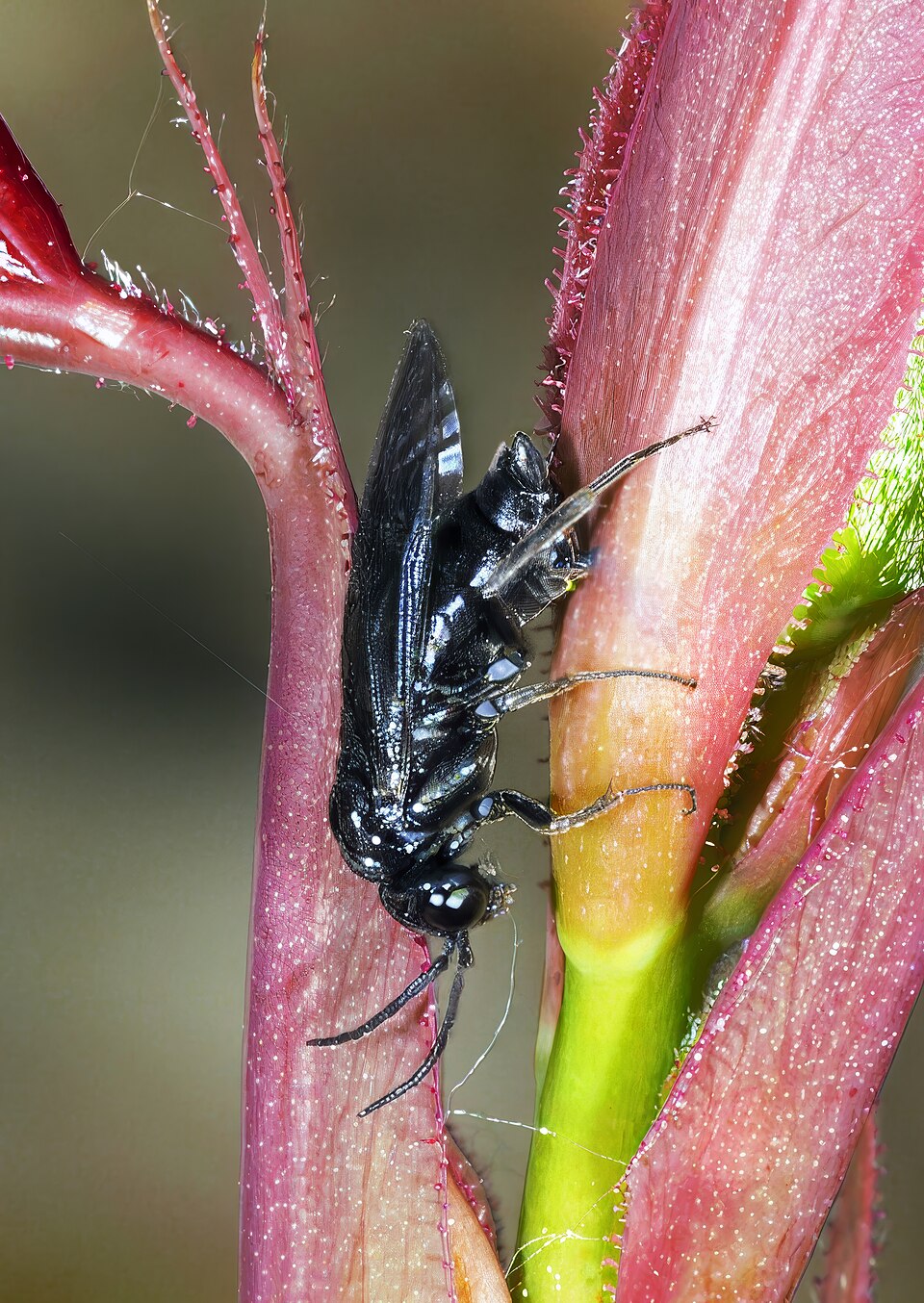
The pear slug sawfly is a small black insect, a cousin of bees and wasps. Its babies look like tiny slimy slugs, because they cover themselves in green slime. They sit on the leaves of fruit trees and munch them down to a see-through skeleton.
How fast is it?
Fun facts
The green slime makes the larvae taste horrible, so birds leave them alone.
A larva sheds its skin five to eight times before it is fully grown.
When it is big enough, the larva drops from the tree and turns into a pupa under the ground.
In New Zealand people let out a tiny wasp that hunts it, to protect their fruit trees.
Carl Linnaeus described it back in 1758.
Most asked questions about Pear slug sawfly
?Is the pear slug a real slug?
No. It is the larva of a sawfly. It only looks like a little slug because of its slime.
?What does the pear slug eat?
Leaves of cherry, pear, plum and hawthorn trees.
For bug experts
- Scientific name
- Caliroa cerasi
- Named by
- Linnaeus, 1758
- Group
- Wasps and hornets
- Family
- Tenthredinidae
- Classification
- Insecta > Hymenoptera > Tenthredinidae
- Lives on
- Europe, Asia, Africa, North America, South America, Australia and Oceania
- Also known as
- Pear slug, Cherry slug
Where the facts come from
- Pear slug (Wikipedia, CC BY-SA 4.0): what it looks like, where it lives, what it eats, sizes and fun facts, retold in simple words.
- Picture by Didier Descouens. CC BY-SA 4.0, Wikimedia Commons. The round sticker of this bug is cut from the same picture.
If we got something wrong, sorry, we are bug fans, not a science journal. Tell us at [email protected] and we will fix it.
 European hornet
 Northern giant hornet
 Bald-faced hornet
 Red velvet ant
 Eastern cicada killer
 Asian hornet
 Alcon blue
 Violet oil beetle
 Red underwing
 Bull-headed dung beetle
 Common scorpionfly
 False potato beetle
_Caliroa_cerasi.jpg)