

Polka-dot wasp moth
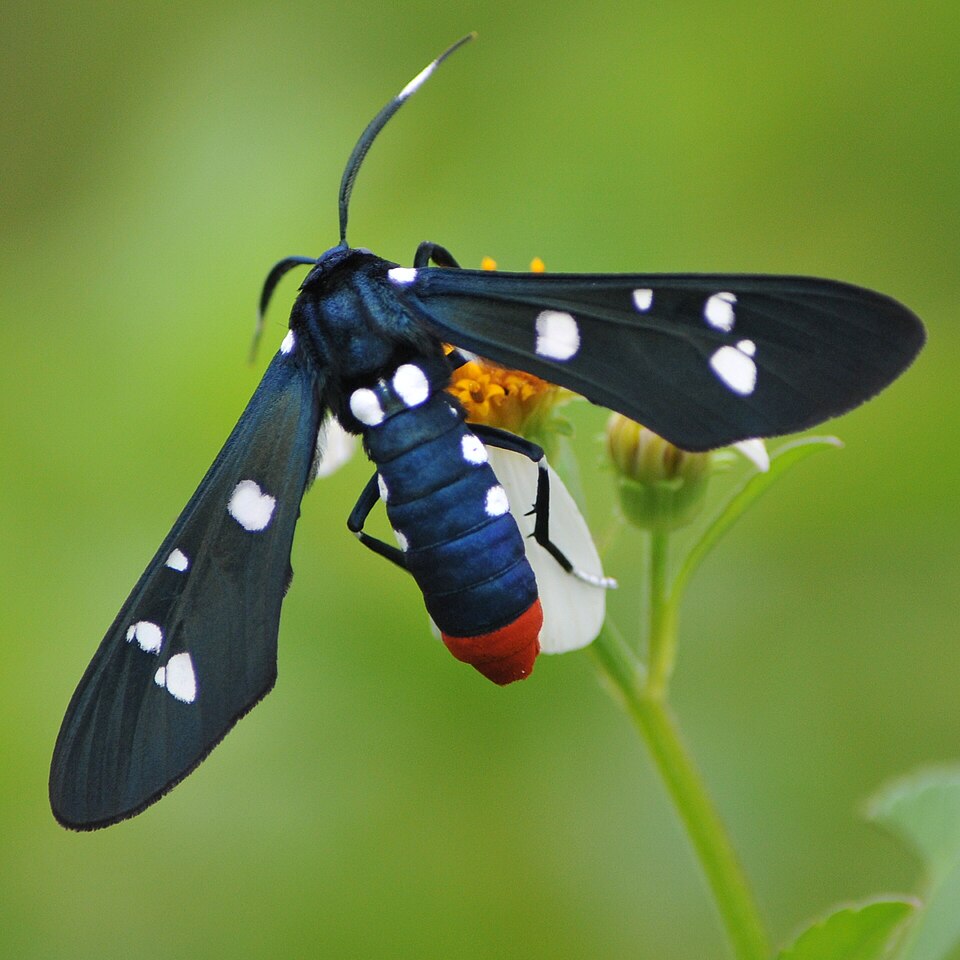
The polka-dot wasp moth is shiny dark blue with white polka dots and a bright red tip on its tail. It is dressed up to look like a dangerous wasp, but it is really a harmless moth. Unlike most moths, it flies in the daytime.
How fast is it?
Fun facts
The female calls the male with very high sounds that people cannot hear. He follows the sound along the branch to find her.
Its caterpillars are famous for being very hungry and can strip an oleander bush bare.
The eggs are tiny pale balls, laid in groups of 12 to 75 under oleander leaves.
Its caterpillars may first have eaten a plant called devil's potato, before Spanish settlers brought oleander to the Americas.
Most asked questions about Polka-dot wasp moth
?Is the polka-dot wasp moth dangerous?
No. It looks like a wasp, but it is a harmless moth that cannot sting.
?What does the oleander caterpillar eat?
Mostly oleander leaves. It sometimes eats devil's potato and desert rose plants too.
?Does the polka-dot wasp moth fly at night?
No, it flies in the daytime, unlike most moths.
Myth buster
Myth: The polka-dot wasp moth is a wasp that can sting.
Truth: No. It is a moth wearing a wasp costume. Its colours trick hungry animals, but it cannot sting at all.
For bug experts
- Scientific name
- Syntomeida epilais
- Group
- Moths
- Family
- Erebidae
- Classification
- Insecta > Lepidoptera > Erebidae
- Lives on
- North America
- Also known as
- Oleander moth
Where the facts come from
- Syntomeida epilais (Wikipedia, CC BY-SA 4.0): what it looks like, where it lives, what it eats, sizes and fun facts, retold in simple words.
- Picture by Andy Blackledge from Scottsdale, AZ, USA. CC BY 2.0, Wikimedia Commons. The round sticker of this bug is cut from the same picture.
If we got something wrong, sorry, we are bug fans, not a science journal. Tell us at [email protected] and we will fix it.
 Atlas moth
 Luna moth
 Hummingbird hawk-moth
 Domestic silk moth
 Isabella tiger moth
 Polyphemus moth
 Scarce swallowtail
 Steelblue ladybird
 Marmalade hoverfly
 Candy-striped leafhopper
 Rainbow scarab
 Spotted cucumber beetle
.jpg)