

Pond olive
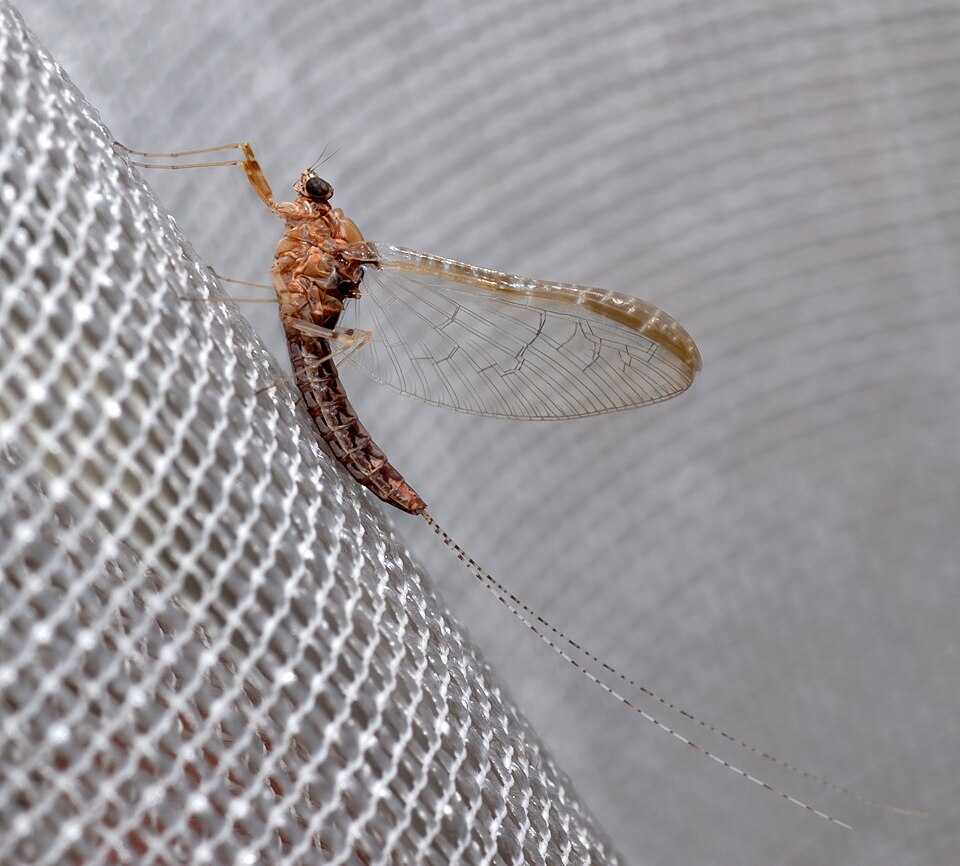
The pond olive is a delicate mayfly with only one pair of wings and long tail threads. It is the most common mayfly in ponds. It is special because the mother keeps her eggs inside until they are ready to hatch.
How fast is it?
Fun facts
The mother keeps her eggs inside her body for 10 to 14 days, and they hatch the moment they touch the water.
The males have extra turban-shaped eyes on top of their heads that help them spot females in a swarm.
Its young can survive for months with almost no oxygen, under the ice of a frozen pond.
In Britain, about 4 in every 10 ponds have pond olives living in them.
In 1953 one was found in America for the first time, and now it lives across North America.
Most asked questions about Pond olive
?How many wings does a pond olive have?
Only two, one pair. That is what its name dipterum means.
?Where do pond olives live?
In ponds across Europe, Asia and North America.
?Do mayflies bite?
No. Mayflies cannot bite or sting, and the grown-ups do not even eat.
For bug experts
- Scientific name
- Cloeon dipterum
- Named by
- Linnaeus, 1761
- Group
- Other insects
- Family
- Baetidae
- Classification
- Insecta > Ephemeroptera > Baetidae
- Lives on
- Europe, Asia, North America
Where the facts come from
- Cloeon dipterum (Wikipedia, CC BY-SA 4.0): what it looks like, where it lives, what it eats, sizes and fun facts, retold in simple words.
- Picture by André Karwath aka Aka. CC BY-SA 2.5, Wikimedia Commons. The round sticker of this bug is cut from the same picture.
If we got something wrong, sorry, we are bug fans, not a science journal. Tell us at [email protected] and we will fix it.
 Common earwig
 Silverfish
 Chigoe flea
 Giant earwig
 Grannom
 Firebrat
 Dragonhunter
 Pennsylvania firefly
 Black saddlebags
 Eastern pondhawk
 Great silver water beetle
 Halloween pennant
.jpg)