
Pubescent carpenter bee
Xylocopa pubescens
Name means: “hairy wood chopper”

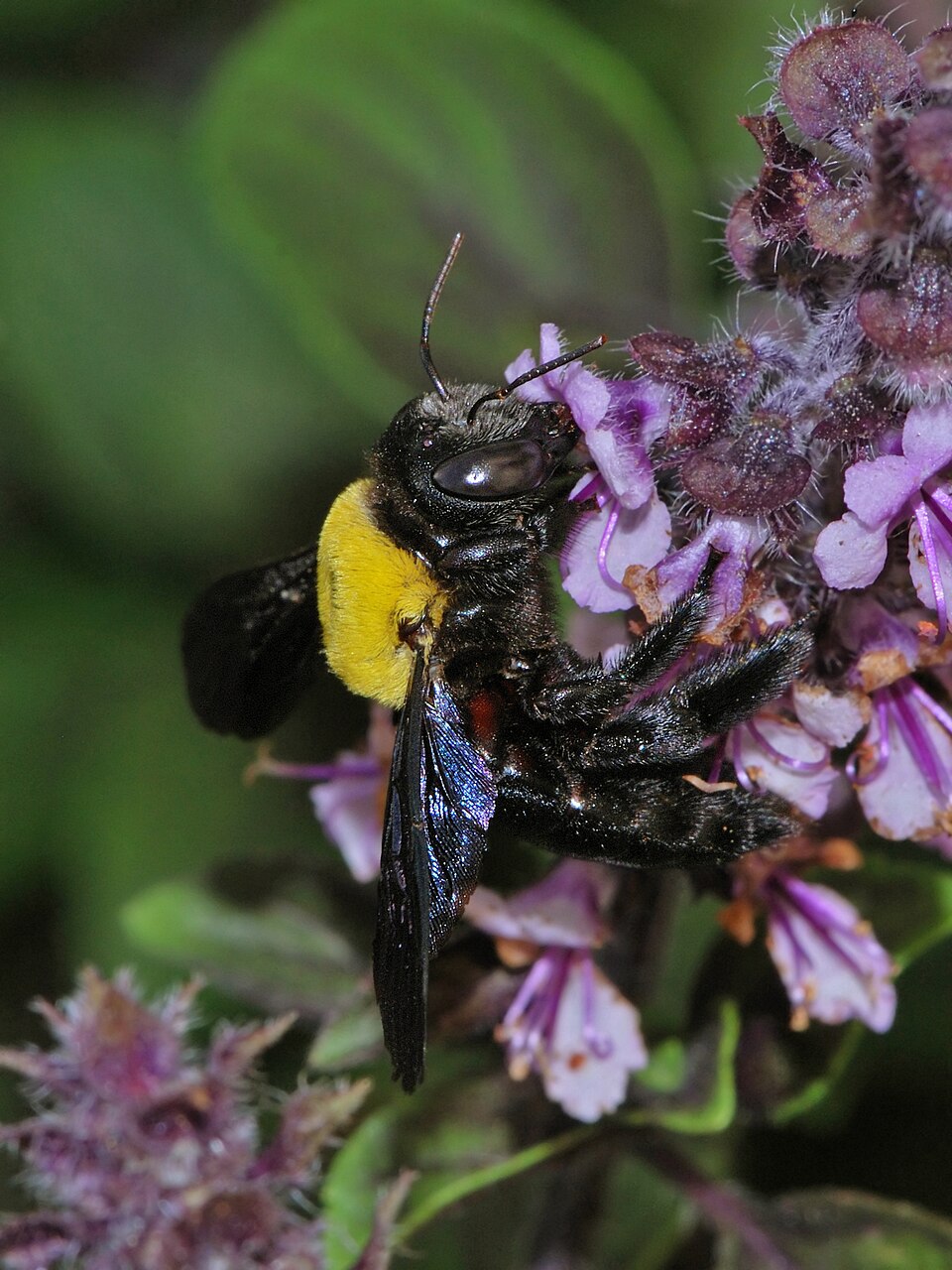
The pubescent carpenter bee is a big bee that chews tunnels into dead wood to make its nest. The female is large, shiny and black with yellow marks on her head. The male is smaller and covered all over in yellow fuzz.
Lives in
North Africa, the Middle East and South Asia, and now Spain and Greece
What does it eat?
It drinks nectar and collects pollen from many kinds of plants to feed its babies.
How fast is it?
A kid running fast about 13 km/h (8.1 mph)
Pubescent carpenter bee about 22 km/h (14 mph)
A grown-up on a bike about 25 km/h (16 mph)
A car driving in town about 50 km/h (31 mph)
cool stuff
Fun facts
1
Its name means hairy wood chopper.
2
It needs warm weather and only goes out to collect food when it is at least 18 degrees.
3
It is a very good pollinator, often better than honey bees.
4
Males guard their own little territories and chase away other males.
5
It marks flowers it has already visited with a special smell.
you asked
Most asked questions about Pubescent carpenter bee
?Why is it called a carpenter bee?
It chews tunnels in dead wood with its jaws to make its nest, like a tiny carpenter.
For bug experts
- Scientific name
- Xylocopa pubescens
- Group
- Bees and bumblebees
- Family
- Apidae
- Classification
- Insecta > Hymenoptera > Apidae
- Lives on
- Africa, Asia, Europe
Where the facts come from
- Xylocopa pubescens (Wikipedia, CC BY-SA 4.0): what it looks like, where it lives, what it eats, sizes and fun facts, retold in simple words.
- Picture by Gideon Pisanty ( Gidip ). CC BY 3.0, Wikimedia Commons. The sticker of this bug is drawn from this picture.
If we got something wrong, sorry, we are bug fans, not a science journal. Tell us at [email protected] and we will fix it.
Bug Wiki honey jar For grown-ups: Bug Wiki is free, with no ads and no tracking. A small tip helps keep it online.Leave a tip Western honey bee
 Buff-tailed bumblebee
 Violet carpenter bee
 Giant honey bee
 Wallace's giant bee
 Himalayan giant honey bee
 Mexican rose tarantula
 Zebra snail
 Lapidary snail
 Greek spoonwing
 Cliveden snail
 Comanche paper wasp