

Purple hairstreak
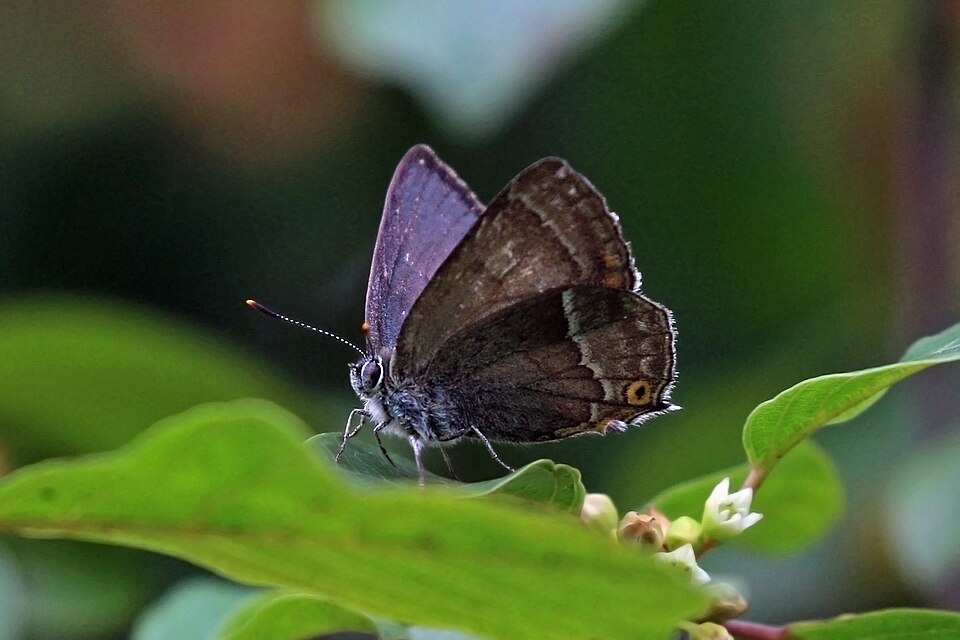
The purple hairstreak is a small butterfly that lives high up in oak trees. The male's wings shine purple in the sun, and its grey underside has a thin white line. Each back wing ends in a tiny tail with two orange spots.
How fast is it?
Fun facts
It spends most of its time fluttering around the tops of oak trees, so people often miss it.
The little caterpillar is ready inside its egg already in summer, but waits there all winter and only comes out in April.
The caterpillar bites its way into young oak shoots to feed.
Its caterpillar was once found safe and sound in a blue tit nest full of baby birds, so birds seem to leave it alone.
Males stay high up in the trees, while females fly lower down to lay their eggs.
Most asked questions about Purple hairstreak
?Where can I see a purple hairstreak?
Look up at the tops of oak trees on warm sunny days in July and August.
?What does the purple hairstreak eat?
The butterflies drink sweet honeydew from leaves, and the caterpillars eat oak.
?Why is it called purple?
Because the male's wings have a shiny purple glow on top.
For bug experts
- Scientific name
- Favonius quercus
- Named by
- Linnaeus, 1758
- Group
- Butterflies
- Family
- Lycaenidae
- Classification
- Insecta > Lepidoptera > Lycaenidae
- Lives on
- Europe, Africa, Asia
Where the facts come from
- Purple hairstreak (Wikipedia, CC BY-SA 4.0): what it looks like, where it lives, what it eats, sizes and fun facts, retold in simple words.
- Picture by Charles J. Sharp. CC BY-SA 4.0, Wikimedia Commons. The round sticker of this bug is cut from the same picture.
If we got something wrong, sorry, we are bug fans, not a science journal. Tell us at [email protected] and we will fix it.
 Monarch butterfly
 Peacock butterfly
 Blue morpho
 Old World swallowtail
 Small white
 Eastern tiger swallowtail
 Stag beetle
 Luna moth
 Northern giant hornet
 Western conifer seed bug
 Rosy maple moth
 Dark fishing spider
_male.jpg)