
Rough harvester ant

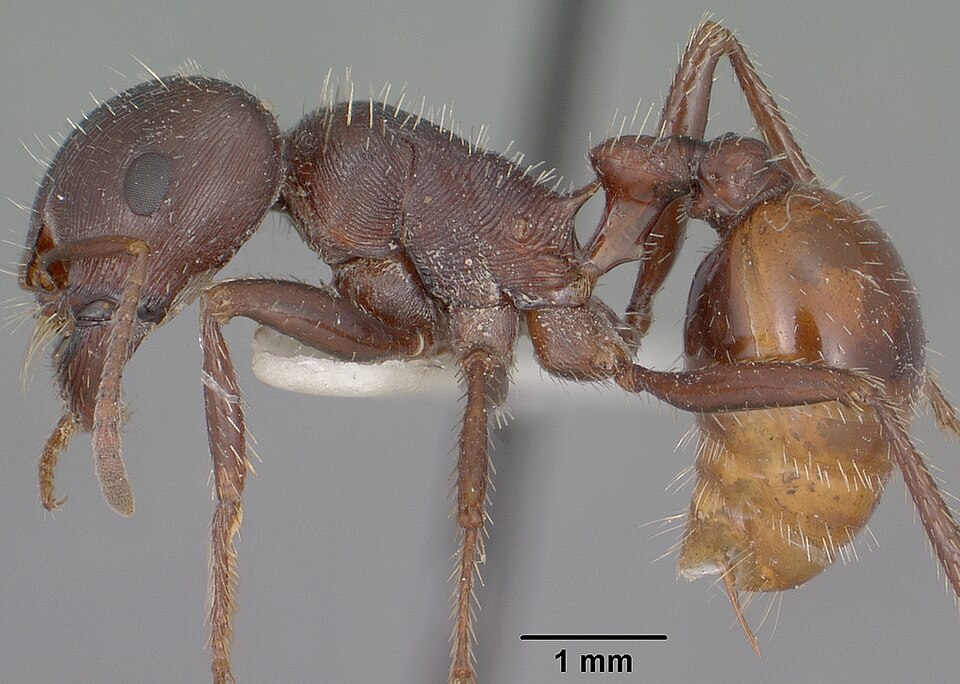
The rough harvester ant lives in hot, sandy deserts. It collects seeds and carries them home to its nest, like a little farmer bringing in the harvest. Around the nest entrance it clears away all the plants, so you can spot the nest easily.
How fast is it?
Fun facts
One colony can have up to 15,000 workers.
Ants in the deserts of California and Arizona are red and black, while those further east are all black.
The workers make permanent paths to their food, like little roads.
Its wedding flights happen on hot summer days, usually after it rained the day before.
Two other kinds of harvester ants have no workers of their own and live inside its nests.
Most asked questions about Rough harvester ant
?What does the rough harvester ant eat?
Mostly seeds, and sometimes dead insects.
For bug experts
- Scientific name
- Pogonomyrmex rugosus
- Group
- Ants
- Family
- Formicidae
- Classification
- Insecta > Hymenoptera > Formicidae
- Lives on
- North America
- Also known as
- Desert harvester ant
Where the facts come from
- Pogonomyrmex rugosus (Wikipedia, CC BY-SA 4.0): what it looks like, where it lives, what it eats, sizes and fun facts, retold in simple words.
- Picture by Jen Fogarty. CC BY 4.0, Wikimedia Commons. The sticker of this bug is drawn from this picture.
If we got something wrong, sorry, we are bug fans, not a science journal. Tell us at [email protected] and we will fix it.
Bug Wiki honey jar For grown-ups: Bug Wiki is free, with no ads and no tracking. A small tip helps keep it online.Leave a tip Black garden ant
 Bullet ant
 Pharaoh ant
 Argentine ant
 Red imported fire ant
 Yellow crazy ant
 Nine-spotted moth
 Desert woodlouse
 Four-spotted antlion
 Desert millipede
 Alkali bee
 Cathedral termite