
Rusty brown birdeater
Acanthoscurria cordubensis

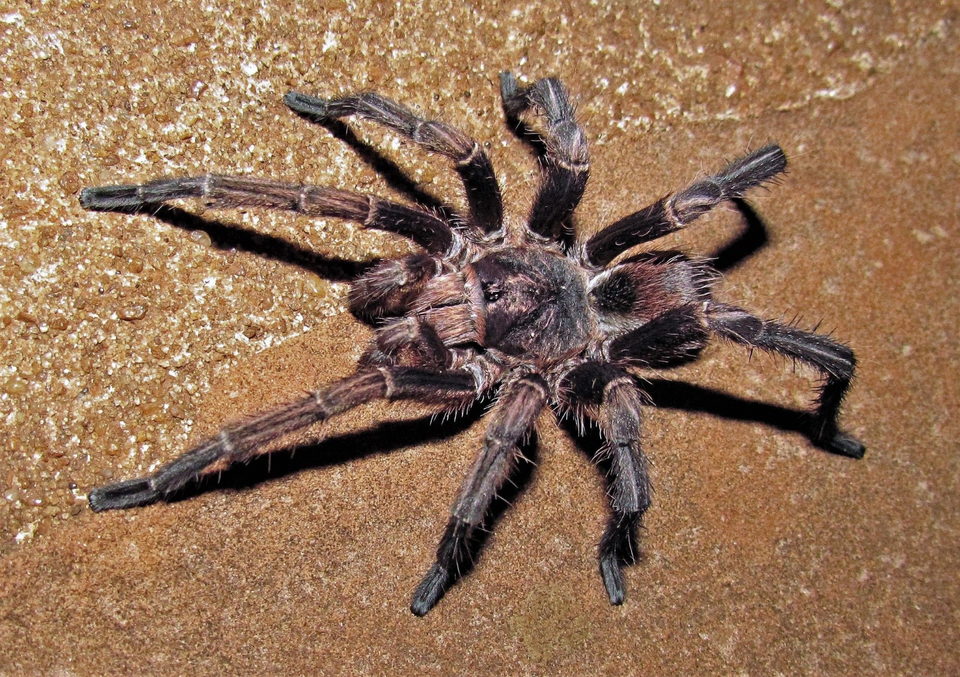
The rusty brown birdeater is a big, medium brown tarantula from Argentina and Uruguay. It lives on the ground in damp places. The females can live for a very long time, up to 20 years.
Fun fact: spiders are not insects. Insects have six legs, spiders have eight. Everyone calls them bugs anyway!
Lives in
Argentina and southern Uruguay, on the ground in damp places
What does it eat?
Like other tarantulas, it hunts insects and other small animals on the ground.
How fast is it?
A tortoise about 0.3 km/h (0.19 mph)
Rusty brown birdeater about 1.5 km/h (0.93 mph)
A person walking about 5 km/h (3.1 mph)
A kid running fast about 13 km/h (8.1 mph)
cool stuff
Fun facts
1
Females can live up to 20 years, but males only live about 4 years.
2
A big female can reach a size of about 19 centimetres, but scientists have only measured a few.
3
It used to have a different scientific name, Acanthoscurria suina.
you asked
Most asked questions about Rusty brown birdeater
?How long does the rusty brown birdeater live?
Females can live up to 20 years. Males live about 4 years.
For bug experts
- Scientific name
- Acanthoscurria cordubensis
- Group
- Spiders
- Family
- Theraphosidae
- Classification
- Arachnida > Araneae > Theraphosidae
- Lives on
- South America
- Also known as
- Rusty brown bird eater
Where the facts come from
- Acanthoscurria cordubensis (Wikipedia, CC BY-SA 4.0): what it looks like, where it lives, what it eats, sizes and fun facts, retold in simple words.
- Picture by Hugo Hulsberg. CC0, Wikimedia Commons. The sticker of this bug is drawn from this picture.
If we got something wrong, sorry, we are bug fans, not a science journal. Tell us at [email protected] and we will fix it.
Bug Wiki honey jar For grown-ups: Bug Wiki is free, with no ads and no tracking. A small tip helps keep it online.Leave a tip European garden spider
 Goliath birdeater
 Brown recluse
 Redback spider
 Yellow garden spider
 Bold jumping spider
 Red-headed ash borer
 Beech blight aphid
 Oak marble gall wasp
 Silver-spotted tiger moth
 Carrion beetle
 Fir tussock moth