

Southern hawker
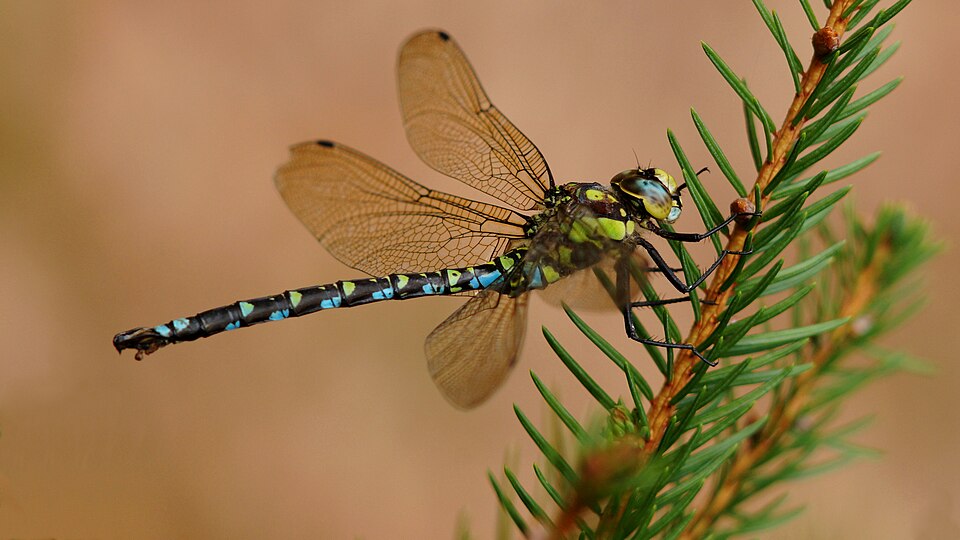
The southern hawker is a big, bright dragonfly with green and blue spots on a dark body. It is very curious and sometimes flies up close to have a look at you. You can often see it zooming around garden ponds and woodland paths.
How big is it?
How long is it?
How wide are its wings?
How big is Southern hawker compared to YOU?
Just maths in your browser. Nothing is saved or sent anywhere.
How fast is it?
Fun facts
It has a black mark shaped like a letter T on its forehead.
Its babies live underwater for two to three years before they turn into flying dragonflies.
Males guard their pond and crash into rival males, spinning around in the air.
The mother lays her eggs by poking her tail into rotting plants or wood near the water.
It can wander hundreds of metres away from water, into fields, parks and even streets.
Most asked questions about Southern hawker
?Can a southern hawker sting?
No. Dragonflies have no stinger and are harmless to people.
?Why does a southern hawker fly close to me?
It is a very curious dragonfly and likes to come and take a look.
?How big is a southern hawker?
It is about 7 centimetres long, with wings up to 11 centimetres across.
Myth buster
Myth: The southern hawker can sting you with its tail.
Truth: No. The little hooks at the end of its tail only look like a stinger. Dragonflies cannot sting at all.
For bug experts
- Scientific name
- Aeshna cyanea
- Group
- Dragonflies and damselflies
- Family
- Aeshnidae
- Classification
- Insecta > Odonata > Aeshnidae
- Lives on
- Europe, Africa
- Also known as
- Blue hawker
Where the facts come from
- Southern hawker (Wikipedia, CC BY-SA 4.0): what it looks like, where it lives, what it eats, sizes and fun facts, retold in simple words.
- Picture by Ebertakis. CC BY-SA 3.0, Wikimedia Commons. The round sticker of this bug is cut from the same picture.
If we got something wrong, sorry, we are bug fans, not a science journal. Tell us at [email protected] and we will fix it.
 Emperor dragonfly
 Common whitetail
 Green darner
 Ebony jewelwing
 Globe skimmer
 Blue dasher
 Great diving beetle
 Water louse
 New Zealand mud snail
 Great pond snail
 Common backswimmer
 Petroleum fly