

Spine-tailed earwig
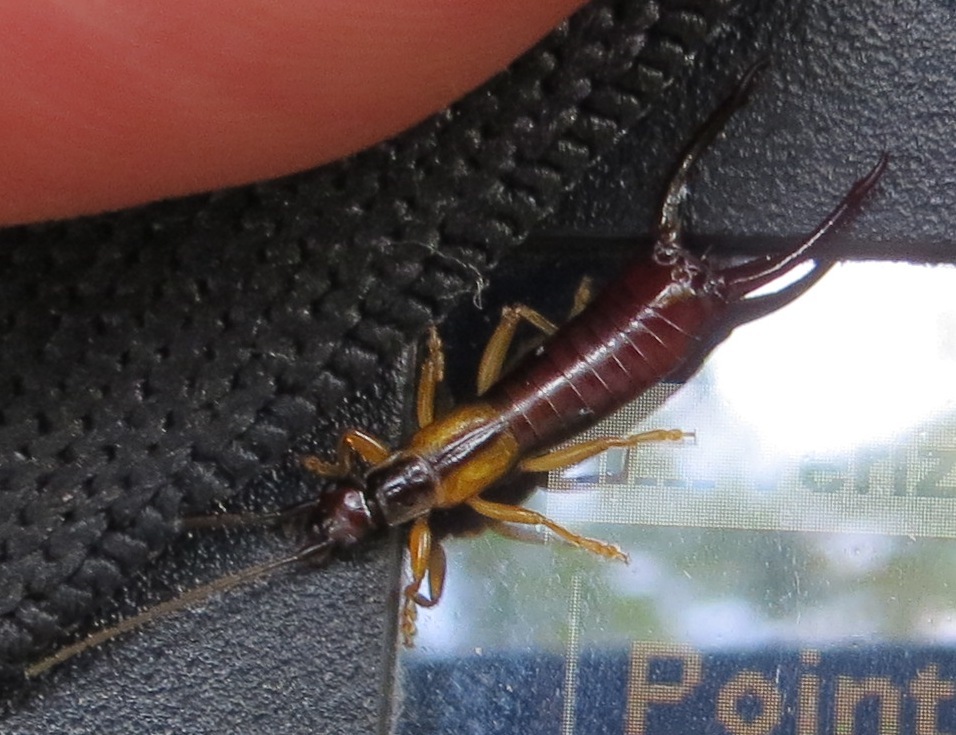
The spine-tailed earwig is a dark brown earwig with yellow legs and a pair of curved pincers on its tail. The boy has a tiny extra spike between his pincers, which gives it its name. It lives in woods and grassy places in eastern North America.
How big is it?
How long is it?
How big is Spine-tailed earwig compared to YOU?
Just maths in your browser. Nothing is saved or sent anywhere.
How fast is it?
Fun facts
It is the only earwig that has always lived in the north of the United States.
On summer nights it often comes to outdoor lamps.
In Canada it hides in the little pockets where young leaves join the stem, in wetlands.
Its back wings are usually tiny, so it mostly walks instead of flying.
The boy's pincers are longer and more curved than the girl's.
Most asked questions about Spine-tailed earwig
?Do earwigs crawl into your ears?
No. That is an old story. Earwigs hide in dark cracks outdoors, not in people's ears.
?Can an earwig hurt you?
Not really. It might give a tiny pinch with its pincers, but it is harmless.
?Why is it called spine-tailed?
Because the boy has a small spike between his tail pincers.
Myth buster
Myth: Earwigs crawl into people's ears.
Truth: No. That is an old story. Earwigs hide in dark cracks outdoors, not in people's ears.
For bug experts
- Scientific name
- Doru aculeatum
- Group
- Other insects
- Family
- Forficulidae
- Classification
- Insecta > Dermaptera > Forficulidae
- Lives on
- North America
Where the facts come from
- Doru aculeatum (Wikipedia, CC BY-SA 4.0): what it looks like, where it lives, what it eats, sizes and fun facts, retold in simple words.
- Picture by Summit County Metro Parks. CC BY 4.0, Wikimedia Commons. The round sticker of this bug is cut from the same picture.
If we got something wrong, sorry, we are bug fans, not a science journal. Tell us at [email protected] and we will fix it.
 Common earwig
 Silverfish
 Chigoe flea
 Giant earwig
 Grannom
 Firebrat
 White-lipped snail
 Citrus swallowtail
 Common banded hoverfly
 Australian painted lady
 Olive fruit fly
 Eastern tailed-blue