

Spongy moth
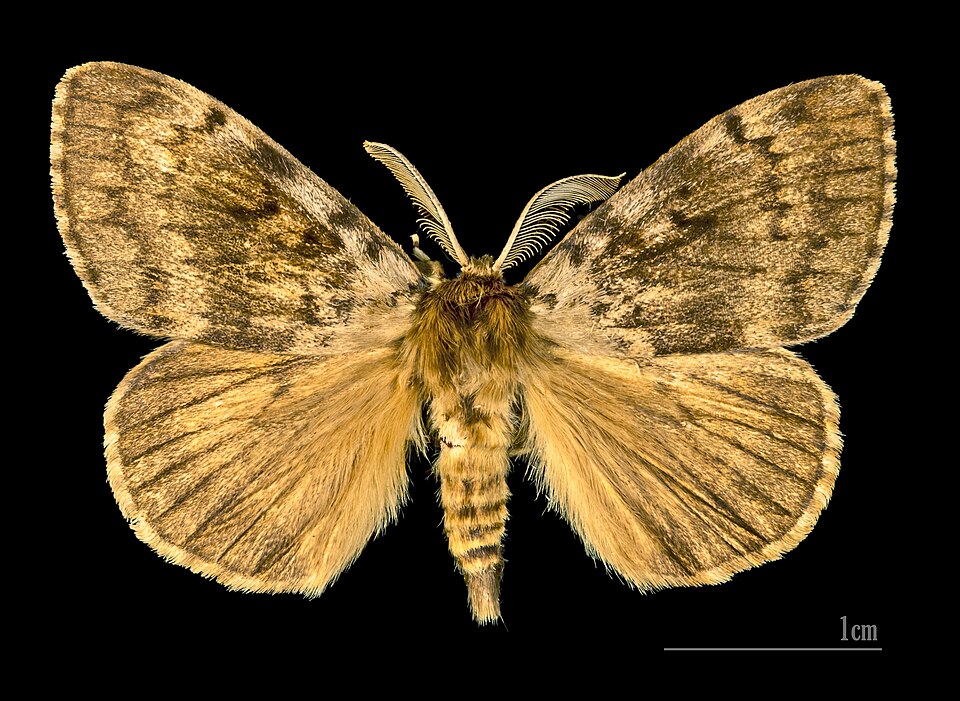
The spongy moth is a moth whose hairy caterpillars have little tufts of hair on their backs. In some years there are so many caterpillars that they eat whole forests bare. The males and females look so different that you might think they are two kinds of moth.
How fast is it?
Fun facts
It is on the list of the 100 worst invasive animals and plants in the world, because it spreads so far and eats so many trees.
It was brought to America in 1869 by an artist who hoped to make silk from it.
Its new name comes from the soft, spongy blob that covers its eggs.
In bad years, people have counted more than 2 million caterpillars on one hectare of forest.
In America it spreads about 21 kilometres further every year.
Most asked questions about Spongy moth
?Why is it called the spongy moth?
Because the female covers her eggs with a soft, spongy mass. Scientists chose the new name in 2022.
?What do spongy moth caterpillars eat?
They eat tree leaves, and in some years they can strip whole forests.
?Where does the spongy moth come from?
It comes from Europe and Asia. People took it to North America, where it became a big pest.
For bug experts
- Scientific name
- Lymantria dispar
- Group
- Moths
- Family
- Erebidae
- Classification
- Insecta > Lepidoptera > Erebidae
- Lives on
- Europe, Asia, North America, South America, Africa
- Also known as
- Gypsy moth
Where the facts come from
- Lymantria dispar (Wikipedia, CC BY-SA 4.0): what it looks like, where it lives, what it eats, sizes and fun facts, retold in simple words.
- Picture by Didier Descouens. CC BY-SA 4.0, Wikimedia Commons. The round sticker of this bug is cut from the same picture.
If we got something wrong, sorry, we are bug fans, not a science journal. Tell us at [email protected] and we will fix it.
 Atlas moth
 Luna moth
 Hummingbird hawk-moth
 Domestic silk moth
 Isabella tiger moth
 Polyphemus moth
 Brimstone butterfly
 Hemlock woolly adelgid
 Telephone-pole beetle
 Six-spotted tiger beetle
 Comma butterfly
 Red-headed centipede