
Three-spined grass bug
Stenodema pilosa
Name means: “three-spined, after the three small spines on its back legs”

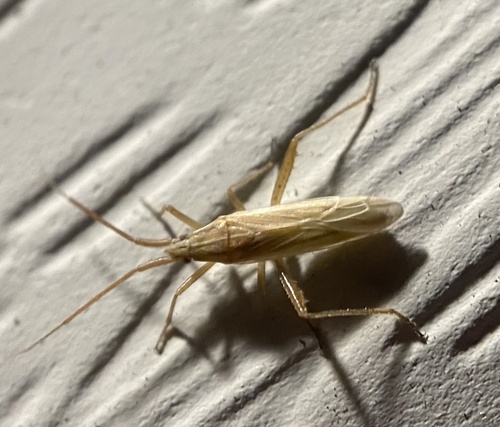
The three-spined grass bug is a long, thin bug that lives in grassy fields and wetlands. It has three tiny spines on each back leg. The ones you see in spring are green with an orange-brown hourglass shape on the back.
Lives in
North America, Europe and Asia, in grassy fields and wetlands
Length
8 to 9 mm (0.31 to 0.35 in)
Can it hurt you?
Harmless
Harmless to people. It only cares about grass.
What does it eat?
It feeds on grasses, such as meadow foxtail, reed canary grass and common reed.
How big is it?
How long is it?
💅small enough to sit on your fingernail🍚as long as 1.5 grains of rice in a row🍽️could run across a dinner table in 21 seconds
How big is Three-spined grass bug compared to YOU?
Just maths in your browser. Nothing is saved or sent anywhere.
How fast is it?
A garden snail about 0.05 km/h (0.03 mph)
Three-spined grass bug about 0.17 km/h (0.11 mph)
A tortoise about 0.3 km/h (0.19 mph)
A person walking about 5 km/h (3.1 mph)
cool stuff
Fun facts
1
Two generations hatch every year.
2
The grown-ups that sleep through winter are green, but the ones born later in the year are beige or tan.
3
The males are often darker than the females.
4
It comes out of its winter rest in April, and the new generation is grown by August.
you asked
Most asked questions about Three-spined grass bug
?How big is the three-spined grass bug?
About 8 to 9 millimetres long.
?What does the three-spined grass bug eat?
Grasses, like meadow foxtail and common reed.
For bug experts
- Scientific name
- Stenodema pilosa
- Group
- True bugs and cicadas
- Family
- Miridae
- Classification
- Insecta > Hemiptera > Miridae
- Lives on
- North America, Europe, Asia
Where the facts come from
- Stenodema pilosa (Wikipedia, CC BY-SA 4.0): what it looks like, where it lives, what it eats, sizes and fun facts, retold in simple words.
- Picture by Mercedes-Fletcher. CC0, Wikimedia Commons. The sticker of this bug is drawn from this picture.
If we got something wrong, sorry, we are bug fans, not a science journal. Tell us at [email protected] and we will fix it.
Bug Wiki honey jar For grown-ups: Bug Wiki is free, with no ads and no tracking. A small tip helps keep it online.Leave a tip Pharaoh cicada
 Spotted lanternfly
 Brown marmorated stink bug
 Cochineal
 Boxelder bug
 Western conifer seed bug
 Common leaf weevil
 Zebra tick
 Maculate ladybird
 Apple leafminer
 Gorgone checkerspot
 The sorcerer