

Vagrant darter
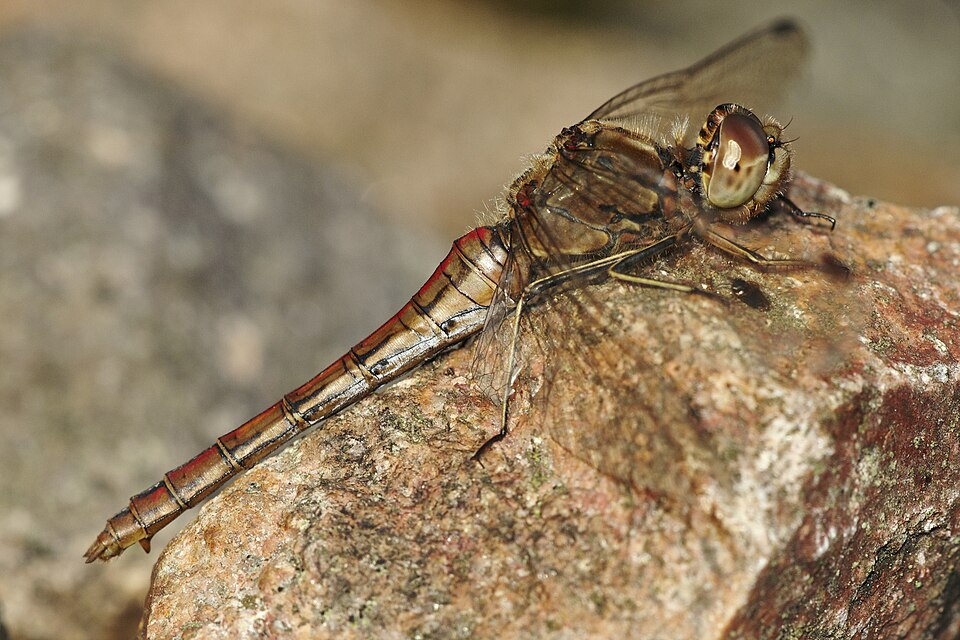
The vagrant darter is a small dragonfly from Europe. It has black lines on the sides of its face that look like a moustache. The male has a red body, and the female is orange and yellow.
How fast is it?
Fun facts
It is called vagrant because now and then one wanders far north, out of its usual home, all the way to Britain.
It looks almost exactly like its cousin the common darter, so people often mix them up.
It lays its eggs in still water such as ponds and lakes.
Young males and grown-up females can look very much alike.
Most asked questions about Vagrant darter
?Why is it called the vagrant darter?
Because some of them sometimes wander far from home, to places like Britain where they do not usually live.
?Is the vagrant darter dangerous?
No. Dragonflies do not sting and are harmless to people.
?How do you tell the male and female apart?
The male has a red body. The female is more orange and yellow.
For bug experts
- Scientific name
- Sympetrum vulgatum
- Named by
- Linnaeus, 1758
- Group
- Dragonflies and damselflies
- Family
- Libellulidae
- Classification
- Insecta > Odonata > Libellulidae
- Lives on
- Europe
- Also known as
- Moustached darter
Where the facts come from
- Vagrant darter (Wikipedia, CC BY-SA 4.0): what it looks like, where it lives, what it eats, sizes and fun facts, retold in simple words.
- Picture by Jörg Hempel. CC BY-SA 3.0 de, Wikimedia Commons. The round sticker of this bug is cut from the same picture.
If we got something wrong, sorry, we are bug fans, not a science journal. Tell us at [email protected] and we will fix it.
 Emperor dragonfly
 Common whitetail
 Green darner
 Ebony jewelwing
 Globe skimmer
 Blue dasher
 Drinker moth
 Common water boatman
 Water scorpion
 Giant salmonfly
 Tisza mayfly
 Green leafhopper