
Window lace-weaver
Amaurobius fenestralis
Name means: “of the window, because it is often found near windows”

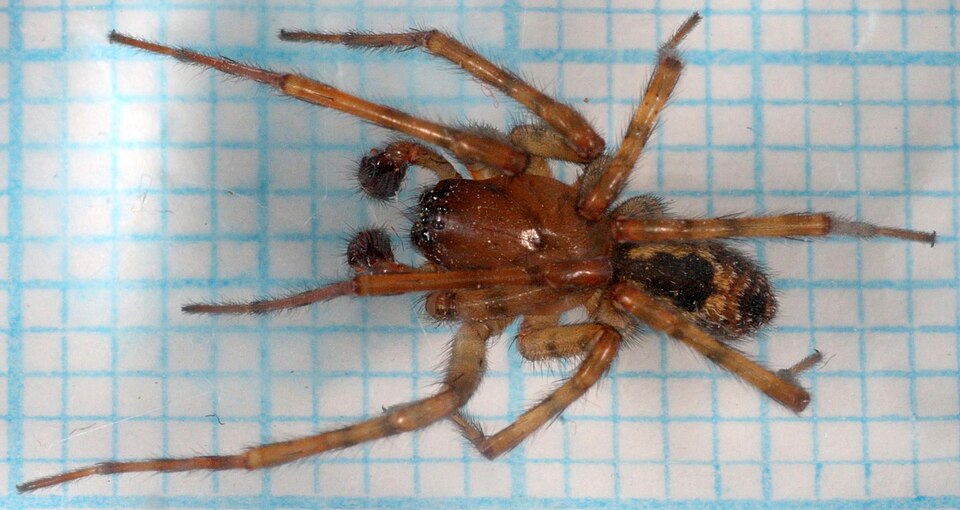
The window lace-weaver is a small spider that likes to live in and around houses. It is often found near windows, and that is where its scientific name comes from. On its back it has a few V-shaped marks.
Fun fact: spiders are not insects. Insects have six legs, spiders have eight. Everyone calls them bugs anyway!
Lives in
Europe, including Britain, in and around houses
What does it eat?
It catches small creatures in its web. It has even been seen eating another kind of spider.
How fast is it?
A tortoise about 0.3 km/h (0.19 mph)
Window lace-weaver about 1.2 km/h (0.75 mph)
A person walking about 5 km/h (3.1 mph)
A kid running fast about 13 km/h (8.1 mph)
cool stuff
Fun facts
1
It looks almost exactly like a cousin spider. Experts sometimes need a microscope to tell them apart.
2
It usually has two or three V-shaped marks on its back, while its cousin usually has four.
3
In Britain it has been seen catching and eating a spider called the false widow.
you asked
Most asked questions about Window lace-weaver
?Why is it called the window spider?
Because it is often found near windows. Its scientific name comes from the Latin word for window.
For bug experts
- Scientific name
- Amaurobius fenestralis
- Group
- Spiders
- Family
- Amaurobiidae
- Classification
- Arachnida > Araneae > Amaurobiidae
- Lives on
- Europe
- Also known as
- Lace-webbed spider
Where the facts come from
- Amaurobius fenestralis (Wikipedia, CC BY-SA 4.0): what it looks like, where it lives, what it eats, sizes and fun facts, retold in simple words.
- Picture by Magne Flåten. CC BY-SA 3.0, Wikimedia Commons. The sticker of this bug is drawn from this picture.
If we got something wrong, sorry, we are bug fans, not a science journal. Tell us at [email protected] and we will fix it.
Bug Wiki honey jar For grown-ups: Bug Wiki is free, with no ads and no tracking. A small tip helps keep it online.Leave a tip European garden spider
 Goliath birdeater
 Brown recluse
 Redback spider
 Yellow garden spider
 Bold jumping spider
 European mouse flea
 House centipede
 German cockroach
 Asian tiger mosquito
 Varied carpet beetle
 Eyelash mite