
Black-tailed red sheetweaver
Florinda coccinea

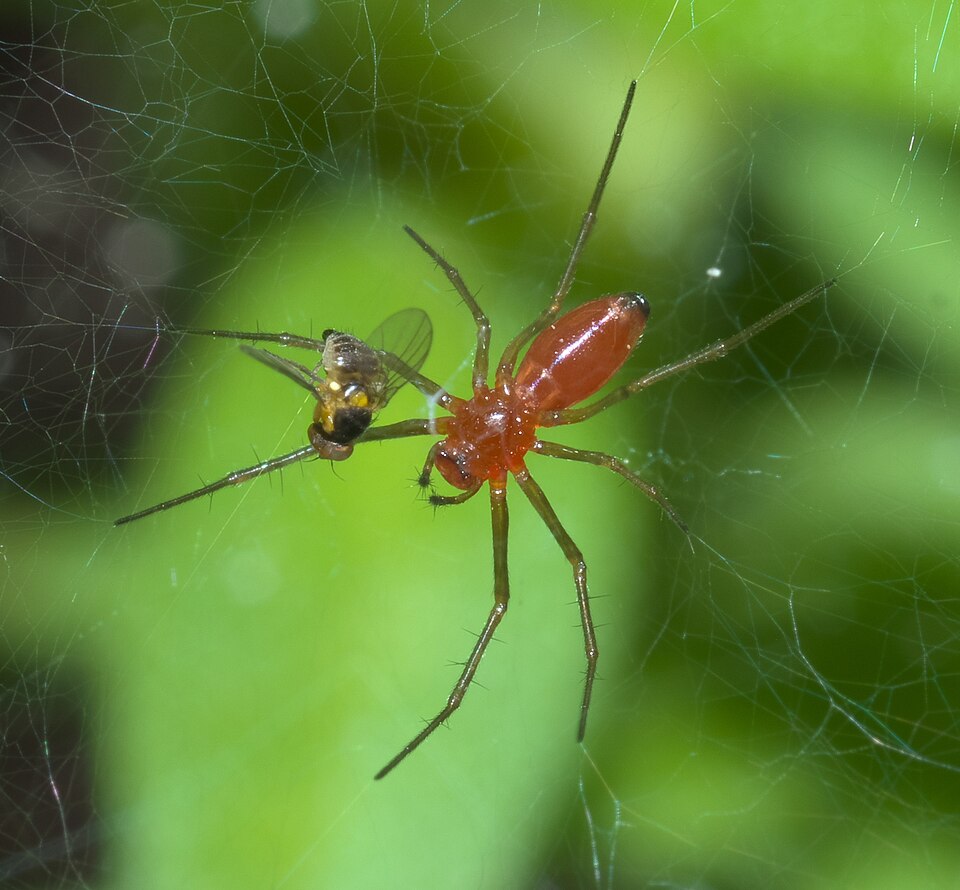
The black-tailed red sheetweaver is a tiny, bright red spider with a black bump at its tail end. It is only about as big as a grain of rice. You can find it in lawns and grassy fields.
Fun fact: spiders are not insects. Insects have six legs, spiders have eight. Everyone calls them bugs anyway!
Lives in
The south-eastern United States, Mexico and the West Indies, in lawns, grassland and fields
Length
3 to 4 mm (0.12 to 0.16 in)
females are a little bigger than malesWhat does it eat?
It eats small flying insects that tumble into its web.
How big is it?
How long is it?
💅small enough to sit on your fingernail🍽️could run across a dinner table in 4.7 seconds⚡moves 53 times its own body length every second
How big is Black-tailed red sheetweaver compared to YOU?
Just maths in your browser. Nothing is saved or sent anywhere.
How fast is it?
A garden snail about 0.05 km/h (0.03 mph)
A tortoise about 0.3 km/h (0.19 mph)
Black-tailed red sheetweaver about 0.76 km/h (0.47 mph)
A person walking about 5 km/h (3.1 mph)
cool stuff
Fun facts
1
Its web is a flat sheet that is not sticky, with a tangle of threads above it.
2
Flying insects bump into the tangle, fall onto the sheet, and the spider rushes out to grab them.
3
It is the only species in its genus.
4
It has eight eyes in two rows: two on top and six below.
you asked
Most asked questions about Black-tailed red sheetweaver
?How does the black-tailed red sheetweaver catch food?
Insects hit the threads above its web, drop onto the flat sheet below, and the spider catches them.
For bug experts
- Scientific name
- Florinda coccinea
- Named by
- O. Pickard-Cambridge, 1896
- Group
- Spiders
- Family
- Linyphiidae
- Classification
- Arachnida > Araneae > Linyphiidae
- Lives on
- North America
- Also known as
- Red grass spider
Where the facts come from
- Blacktailed red sheetweaver (Wikipedia, CC BY-SA 4.0): what it looks like, where it lives, what it eats, sizes and fun facts, retold in simple words.
- Picture by xpda. CC BY-SA 4.0, Wikimedia Commons. The sticker of this bug is drawn from this picture.
If we got something wrong, sorry, we are bug fans, not a science journal. Tell us at [email protected] and we will fix it.
Bug Wiki honey jar For grown-ups: Bug Wiki is free, with no ads and no tracking. A small tip helps keep it online.Leave a tip European garden spider
 Goliath birdeater
 Brown recluse
 Redback spider
 Yellow garden spider
 Bold jumping spider
 Discolored lady beetle
 Knapweed root weevil
 New Forest burnet
 The spectacle
 Fire-flag plume moth
 Bent-lined carpet