
Citrine forktail

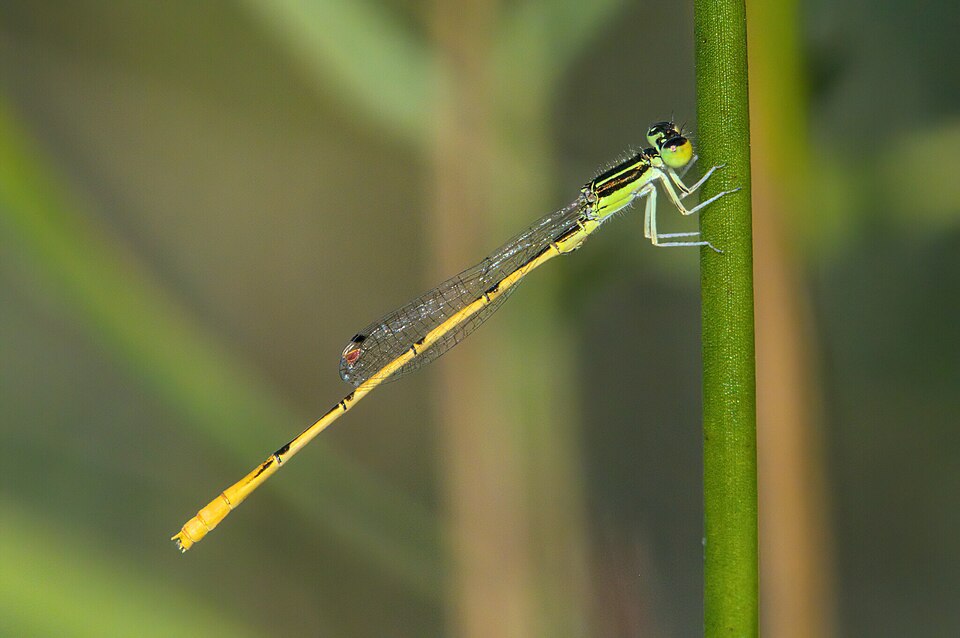
The citrine forktail is a tiny damselfly, much smaller than most of its relatives in Europe. The male has a black head and chest with blue marks and a bright yellow tail. It flits low over the plants beside ponds and marshes.
How big is it?
How long is it?
How big is Citrine forktail compared to YOU?
Just maths in your browser. Nothing is saved or sent anywhere.
How fast is it?
Fun facts
Citrine means lemon yellow, and the name comes from the male's yellow tail.
Young females are mostly orange. As they grow up they turn brownish, then olive, then greyish.
The male is the only damselfly in the world whose little wing spot sits away from the front edge of the wing.
On the Azores islands the females lay eggs that hatch without any males. No other dragonfly or damselfly group in the world is known to do this.
In the warm south of the United States, adults can be seen flying all year round.
Most asked questions about Citrine forktail
?How big is a citrine forktail?
It is only about 2 to 2.7 centimetres long, one of the smallest damselflies.
?Where does the citrine forktail live?
It lives in North and South America, and there is also a group on the Azores islands in the Atlantic.
For bug experts
- Scientific name
- Ischnura hastata
- Group
- Dragonflies and damselflies
- Family
- Coenagrionidae
- Classification
- Insecta > Odonata > Coenagrionidae
- Lives on
- North America, South America, Europe
Where the facts come from
- Citrine forktail (Wikipedia, CC BY-SA 4.0): what it looks like, where it lives, what it eats, sizes and fun facts, retold in simple words.
- Picture by Zvkemp. CC BY 4.0, Wikimedia Commons. The sticker of this bug is drawn from this picture.
If we got something wrong, sorry, we are bug fans, not a science journal. Tell us at [email protected] and we will fix it.
Bug Wiki honey jar For grown-ups: Bug Wiki is free, with no ads and no tracking. A small tip helps keep it online.Leave a tip Emperor dragonfly
 Common whitetail
 Green darner
 Ebony jewelwing
 Globe skimmer
 Blue dasher
 Meadow slug
 Amber snail
 Green leafhopper
 Large marsh horse fly
 Seashore springtail
 Baltic isopod