
Crackling forest grasshopper
Trimerotropis verruculata
Name means: “named for the cracking sound it makes in flight; its Latin name means warty, for its rough, mottled look”

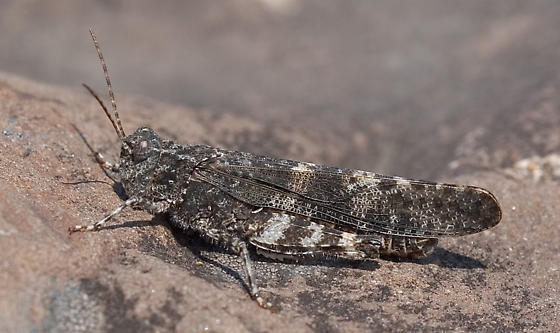
The crackling forest grasshopper makes a loud cracking sound when it flies. It is mottled and bumpy, so it almost disappears on gravel and rock. It is a band-winged grasshopper from North America.
Lives in
North America, on gravel, rocks and ledges
Can it hurt you?
Harmless
Harmless. It cannot sting.
What does it eat?
Like other grasshoppers, it eats plants.
How fast is it?
A person walking about 5 km/h (3.1 mph)
Crackling forest grasshopper about 10 km/h (6.2 mph)
A kid running fast about 13 km/h (8.1 mph)
A grown-up on a bike about 25 km/h (16 mph)
cool stuff
Fun facts
1
Its name comes from the crackling noise it makes while flying.
2
Its rough, spotty look helps it hide on bare gravel and rock.
3
Scientists know two subspecies of it.
you asked
Most asked questions about Crackling forest grasshopper
?Why does the crackling forest grasshopper crackle?
It makes a cracking sound with its wings when it flies.
?Where does the crackling forest grasshopper live?
In North America, often on bare gravel, rock and stony ledges.
For bug experts
- Scientific name
- Trimerotropis verruculata
- Group
- Grasshoppers and crickets
- Family
- Acrididae
- Classification
- Insecta > Orthoptera > Acrididae
- Lives on
- North America
- Also known as
- Cracker grasshopper
Where the facts come from
- Trimerotropis verruculata (Wikipedia, CC BY-SA 4.0): what it looks like, where it lives, what it eats, sizes and fun facts, retold in simple words.
- Picture by Mike Boone. CC BY-SA 2.5, Wikimedia Commons. The sticker of this bug is drawn from this picture.
If we got something wrong, sorry, we are bug fans, not a science journal. Tell us at [email protected] and we will fix it.
Bug Wiki honey jar For grown-ups: Bug Wiki is free, with no ads and no tracking. A small tip helps keep it online.Leave a tip Desert locust
 House cricket
 Parktown prawn
 Eastern lubber grasshopper
 Australian plague locust
 Mormon cricket
 Tarantula wolf spider
 Chilean rose tarantula
 Blue death-feigning beetle
 Red widow
 Giant vinegaroon
 Mexican redrump tarantula