
Desert sand grasshopper
Sphingonotus rubescens

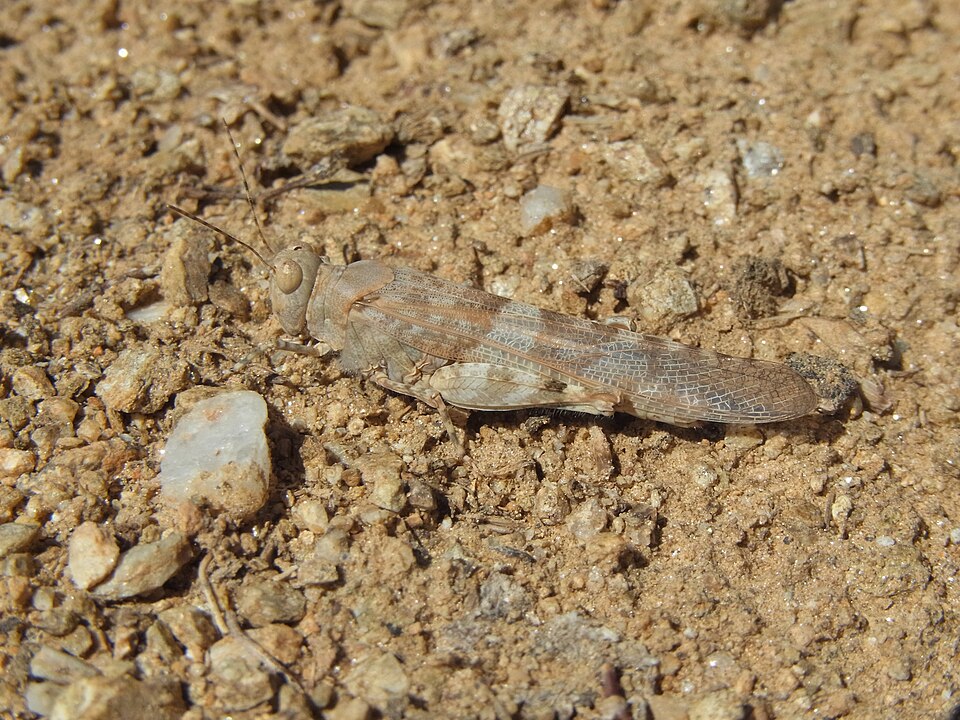
The desert sand grasshopper is a band-winged grasshopper that lives in dry, sandy places. Like other grasshoppers, it has strong back legs for big jumps. It lives across a huge area of Europe, North Africa and Asia.
Lives in
Dry lands of Europe, North Africa and Asia
Can it hurt you?
Harmless
Harmless. It does not bite or sting people.
What does it eat?
Like other grasshoppers, it munches on plants.
How fast is it?
A person walking about 5 km/h (3.1 mph)
Desert sand grasshopper about 10 km/h (6.2 mph)
A kid running fast about 13 km/h (8.1 mph)
A grown-up on a bike about 25 km/h (16 mph)
cool stuff
Fun facts
1
Scientists split it into six kinds, called subspecies.
2
One of its kinds is named after Afghanistan.
3
It was first described in 1870, more than 150 years ago.
you asked
Most asked questions about Desert sand grasshopper
?Is the desert sand grasshopper dangerous?
No. It is a grasshopper and harmless to people.
?Where does the desert sand grasshopper live?
In dry, sandy places across Europe, North Africa and Asia.
For bug experts
- Scientific name
- Sphingonotus rubescens
- Named by
- Walker, 1870
- Group
- Grasshoppers and crickets
- Family
- Acrididae
- Classification
- Insecta > Orthoptera > Acrididae
- Lives on
- Europe, Africa, Asia
Where the facts come from
- Sphingonotus rubescens (Wikipedia, CC BY-SA 4.0): what it looks like, where it lives, what it eats, sizes and fun facts, retold in simple words.
- Picture by Donkey shot. CC BY-SA 3.0, Wikimedia Commons. The sticker of this bug is drawn from this picture.
If we got something wrong, sorry, we are bug fans, not a science journal. Tell us at [email protected] and we will fix it.
Bug Wiki honey jar For grown-ups: Bug Wiki is free, with no ads and no tracking. A small tip helps keep it online.Leave a tip Desert locust
 House cricket
 Parktown prawn
 Eastern lubber grasshopper
 Australian plague locust
 Mormon cricket
 Giant mesquite bug
 Transvaal thick-tailed scorpion
 Brazilian blue tarantula
 European beewolf
 Desert woodlouse
 Four-spotted antlion