
One-eyed centipede
Lamyctes emarginatus
Eats: Other bugs and small animalsCentipedes and millipedesGardens and meadowsNot an insect, but a bug cousin

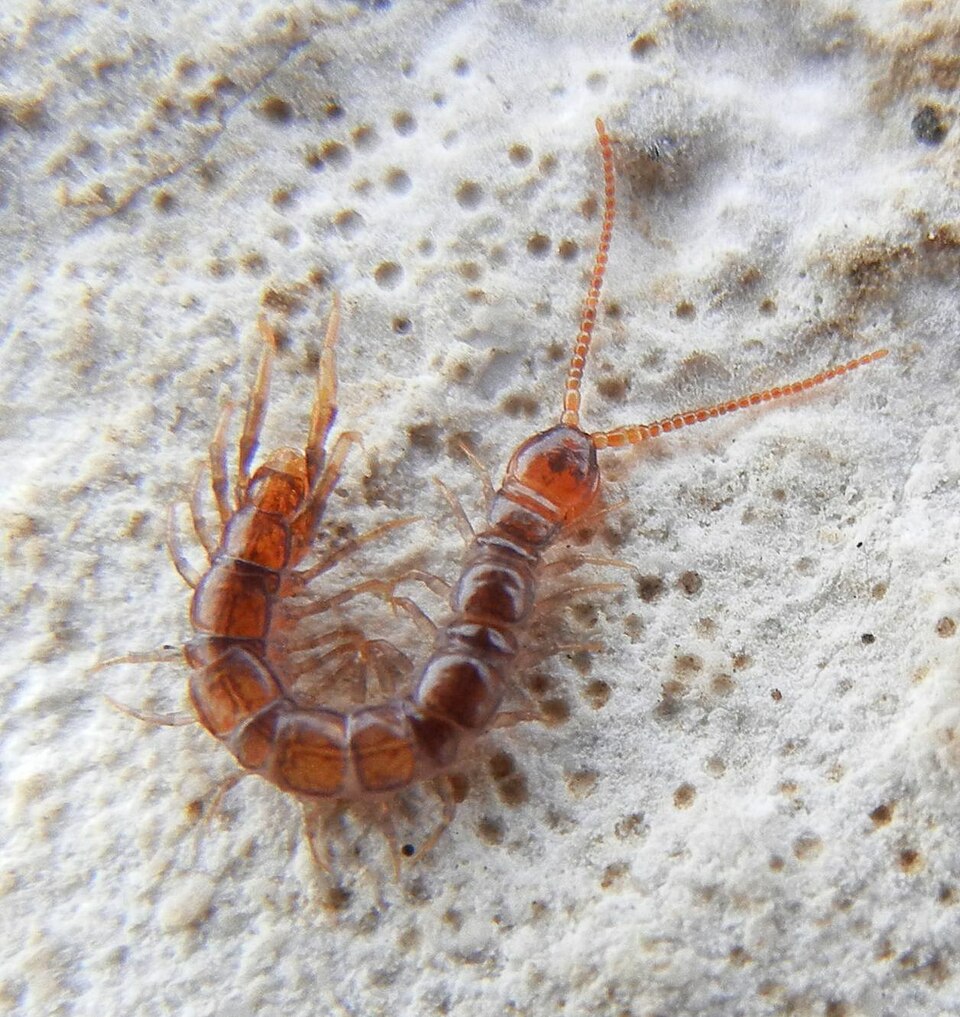
The one-eyed centipede is a small centipede that lives in soil and fallen leaves. It is a loner and goes hunting on its own. It has spread to amazing places all over the world, from Greenland to the Galapagos Islands.
Fun fact: this one is not an insect. Insects have six legs, and this cousin has many, many more.
Lives in
Many parts of the world, including Europe, Africa, New Zealand, Australia, Greenland and the Galapagos Islands
What does it eat?
It is a hunter and catches tiny animals in the soil and leaf litter.
How fast is it?
A tortoise about 0.3 km/h (0.19 mph)
One-eyed centipede about 1.5 km/h (0.93 mph)
A person walking about 5 km/h (3.1 mph)
A kid running fast about 13 km/h (8.1 mph)
cool stuff
Fun facts
1
It was first described in 1844 by a British insect scientist named George Newport.
2
The very first one described by scientists came from New Zealand.
3
It lives in cold Greenland and on the warm Galapagos Islands, which is a huge range for a tiny centipede.
you asked
Most asked questions about One-eyed centipede
?Where does the one-eyed centipede live?
In soil and fallen leaves in many parts of the world, from Europe and Africa to New Zealand, Greenland and the Galapagos Islands.
For bug experts
- Scientific name
- Lamyctes emarginatus
- Named by
- Newport, 1844
- Group
- Centipedes and millipedes
- Family
- Henicopidae
- Classification
- Chilopoda > Lithobiomorpha > Henicopidae
- Lives on
- Europe, Africa, Australia and Oceania, North America, South America
Where the facts come from
- Lamyctes emarginatus (Wikipedia, CC BY-SA 4.0): what it looks like, where it lives, what it eats, sizes and fun facts, retold in simple words.
- Picture by Jon Mortin. CC BY 4.0, Wikimedia Commons. The sticker of this bug is drawn from this picture.
If we got something wrong, sorry, we are bug fans, not a science journal. Tell us at [email protected] and we will fix it.
Bug Wiki honey jar For grown-ups: Bug Wiki is free, with no ads and no tracking. A small tip helps keep it online.Leave a tip Giant African millipede
 House centipede
 Amazonian giant centipede
 Vietnamese centipede
 Giant desert centipede
 Greenhouse millipede
 Three spotted nettle bug
 Black-veined moth
 White-lipped blood bee
 Texas unicorn mantis
 Giant strong-nosed stink bug
 Southern ant