
Western lynx spider
Oxyopes scalaris

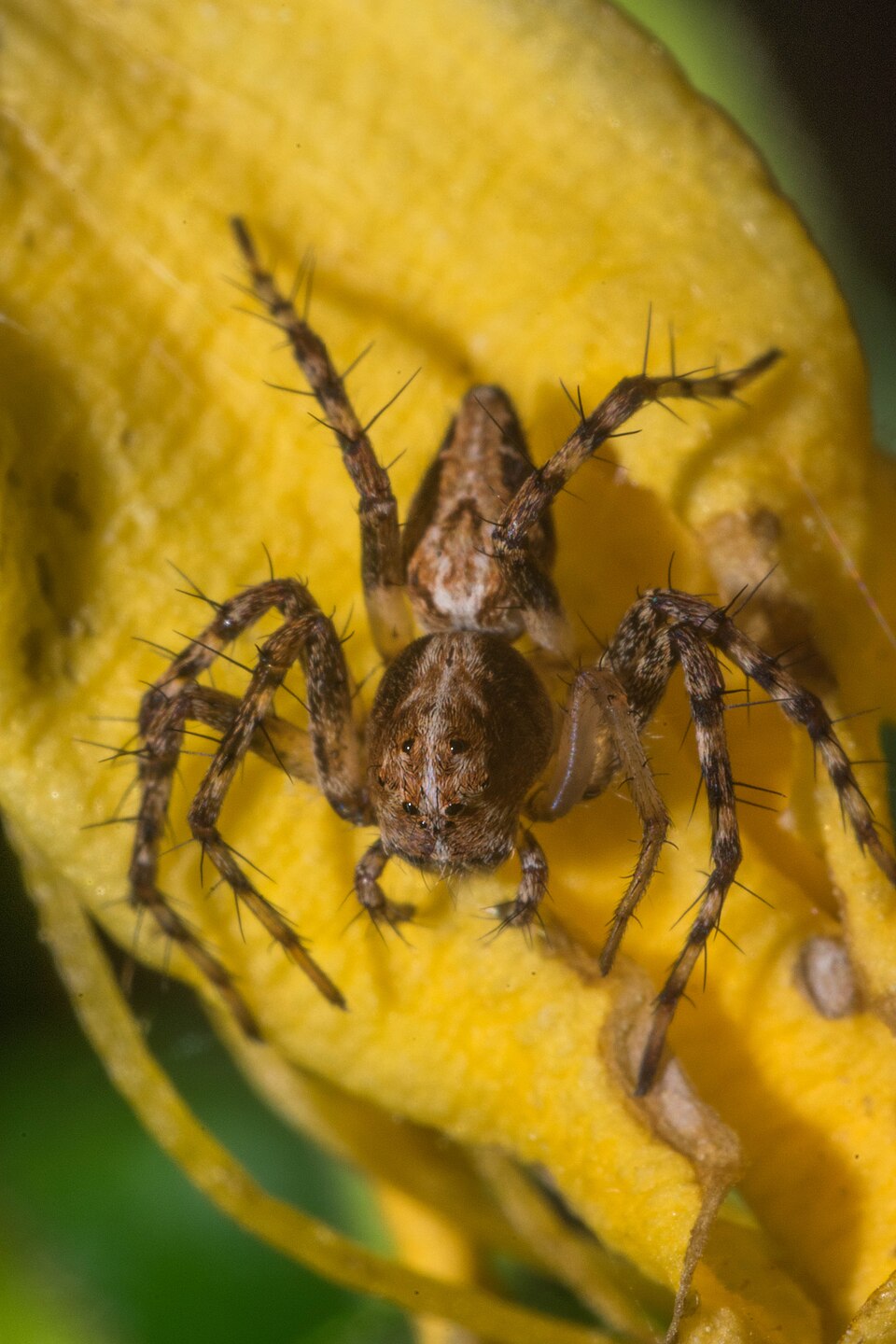
The western lynx spider is a quick hunter that does not build a web. It has long, spiny bristles on its legs and very good eyes. It waits on plants, bushes and trees, then runs or leaps onto its prey.
Fun fact: spiders are not insects. Insects have six legs, spiders have eight. Everyone calls them bugs anyway!
Lives in
North America, on plants, bushes and trees
What does it eat?
It catches small insects that land on the plants where it waits.
How fast is it?
A tortoise about 0.3 km/h (0.19 mph)
Western lynx spider about 1.2 km/h (0.75 mph)
A person walking about 5 km/h (3.1 mph)
A kid running fast about 13 km/h (8.1 mph)
cool stuff
Fun facts
1
Its long spiny bristles make a little basket like cage that may help it hold on to its prey.
2
It does not spin webs, but it still uses silk for safety lines and for its egg sacs.
3
Fruit growers like it, because it eats insects in their orchards.
4
It is most busy in spring and early summer.
you asked
Most asked questions about Western lynx spider
?Does the western lynx spider make a web?
No. It hunts by running and jumping, and only uses silk for safety lines and egg sacs.
For bug experts
- Scientific name
- Oxyopes scalaris
- Group
- Spiders
- Family
- Oxyopidae
- Classification
- Arachnida > Araneae > Oxyopidae
- Lives on
- North America
Where the facts come from
- Oxyopes scalaris (Wikipedia, CC BY-SA 4.0): what it looks like, where it lives, what it eats, sizes and fun facts, retold in simple words.
- Picture by Mangodreads. CC BY-SA 4.0, Wikimedia Commons. The sticker of this bug is drawn from this picture.
If we got something wrong, sorry, we are bug fans, not a science journal. Tell us at [email protected] and we will fix it.
Bug Wiki honey jar For grown-ups: Bug Wiki is free, with no ads and no tracking. A small tip helps keep it online.Leave a tip European garden spider
 Goliath birdeater
 Brown recluse
 Redback spider
 Yellow garden spider
 Bold jumping spider
 Slender green-winged grasshopper
 Rufous-legged grasshopper
 Yellow-winged pareuchaetes moth
 Lupine aphid
 Clover looper moth
 Large banded grasshopper
.jpg)