
Swifts' ant-hunter spider
Zenodorus swiftorum
Name means: “named after Kristin and John Swift, who helped protect nature in New Guinea”
Eats: Other bugs and small animalsSpidersRainforests and jungles8 legsNot an insect, but a bug cousin

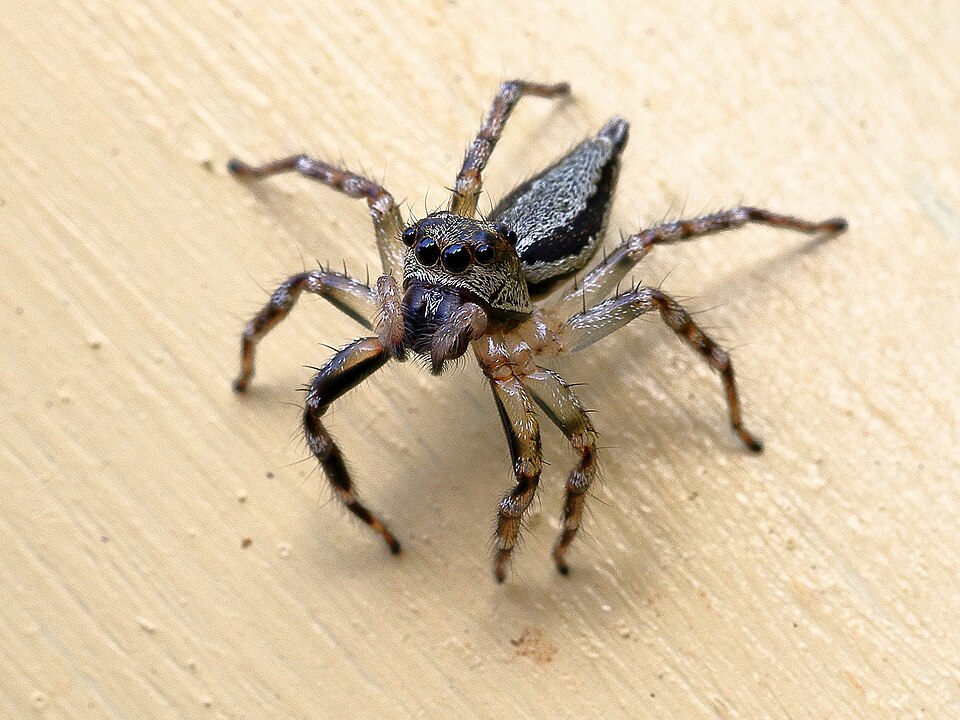
Swifts' ant-hunter spider is a small jumping spider from tropical Australia and New Guinea. As its name says, it hunts ants. It is common, but its looks change a lot from one spider to the next.
Fun fact: spiders are not insects. Insects have six legs, spiders have eight. Everyone calls them bugs anyway!
Lives in
Papua New Guinea and northern Australia
What does it eat?
It is a hunter that catches ants by sneaking up and pouncing on them.
How fast is it?
A garden snail about 0.05 km/h (0.03 mph)
A tortoise about 0.3 km/h (0.19 mph)
Swifts' ant-hunter spider about 0.8 km/h (0.5 mph)
A person walking about 5 km/h (3.1 mph)
cool stuff
Fun facts
1
It belongs to a group of jumping spiders that hunt ants.
2
It is common in tropical Australia, but different spiders can look quite different.
3
The females are a little bigger than the males.
you asked
Most asked questions about Swifts' ant-hunter spider
?What does Swifts' ant-hunter spider eat?
It hunts ants.
For bug experts
- Scientific name
- Zenodorus swiftorum
- Group
- Spiders
- Family
- Salticidae
- Classification
- Arachnida > Araneae > Salticidae
- Lives on
- Australia and Oceania
- Also known as
- Swifts' ant-hunter
Where the facts come from
- Zenodorus swiftorum (Wikipedia, CC BY-SA 4.0): what it looks like, where it lives, what it eats, sizes and fun facts, retold in simple words.
- Picture by G. Winterflood. CC BY-SA 4.0, Wikimedia Commons. The sticker of this bug is drawn from this picture.
If we got something wrong, sorry, we are bug fans, not a science journal. Tell us at [email protected] and we will fix it.
Bug Wiki honey jar For grown-ups: Bug Wiki is free, with no ads and no tracking. A small tip helps keep it online.Leave a tip European garden spider
 Goliath birdeater
 Brown recluse
 Redback spider
 Yellow garden spider
 Bold jumping spider
 Streaked sphinx
 Horse paper wasp
 Common mangrove buckeye
 Blue glassy tiger
 Dark owl-butterfly
 Striped albatross