
Black-veined moth

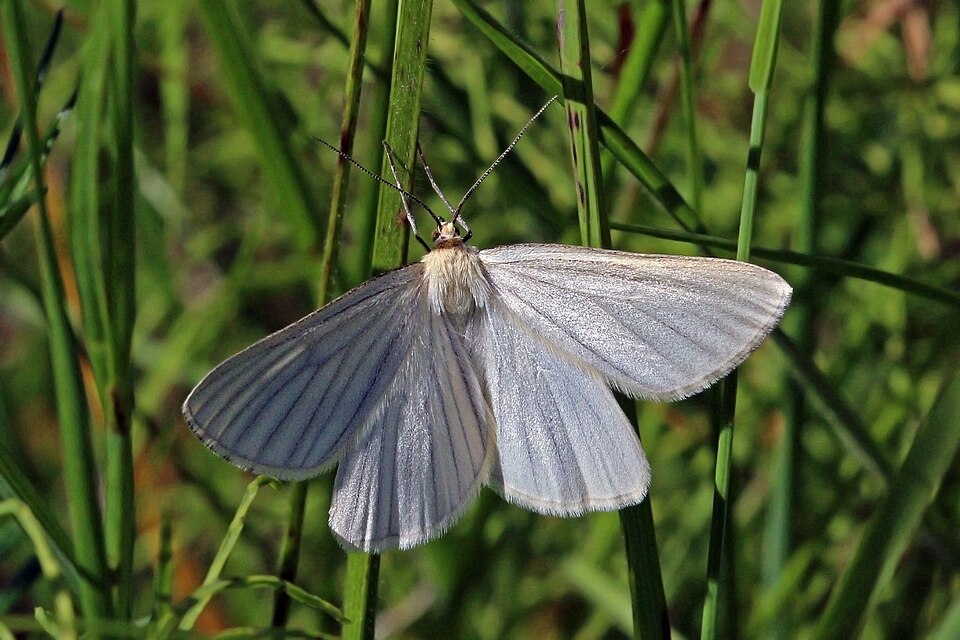
The black-veined moth has white or cream wings with dark lines along the veins, like a drawing. It flies during the day over grassy places. As it gets older, its wings get whiter and the black veins show through more and more.
How big is it?
How wide are its wings?
How big is Black-veined moth compared to YOU?
Just maths in your browser. Nothing is saved or sent anywhere.
How fast is it?
Fun facts
Fresh moths are cream coloured, old ones are whiter because their scales rub off.
Females are smaller than males and have three black lines along their bodies.
The male's body curves upwards at the end.
In Britain it is very rare and lives only in east Kent.
It flies in May and June.
Most asked questions about Black-veined moth
?When does the black-veined moth fly?
In daytime, from the beginning of May to the end of June.
?Why do the black veins get clearer with age?
The tiny scales on its wings rub off, so the dark veins underneath show through.
For bug experts
- Scientific name
- Siona lineata
- Named by
- Scopoli, 1763
- Group
- Moths
- Family
- Geometridae
- Classification
- Insecta > Lepidoptera > Geometridae
- Lives on
- Europe, Asia
Where the facts come from
- Siona lineata (Wikipedia, CC BY-SA 4.0): what it looks like, where it lives, what it eats, sizes and fun facts, retold in simple words.
- Picture by Charles J. Sharp. CC BY-SA 4.0, Wikimedia Commons. The sticker of this bug is drawn from this picture.
If we got something wrong, sorry, we are bug fans, not a science journal. Tell us at [email protected] and we will fix it.
Bug Wiki honey jar For grown-ups: Bug Wiki is free, with no ads and no tracking. A small tip helps keep it online.Leave a tip Atlas moth
 Luna moth
 Hummingbird hawk-moth
 Domestic silk moth
 Isabella tiger moth
 Polyphemus moth
 Yellow cereal fly
 Two-spined grass bug
 Short-tailed aphideater
 Common dewdrop spider
 Popeye dung beetle
 Raspberry gall midge
.jpg)