
Devastating grasshopper
Melanoplus devastator

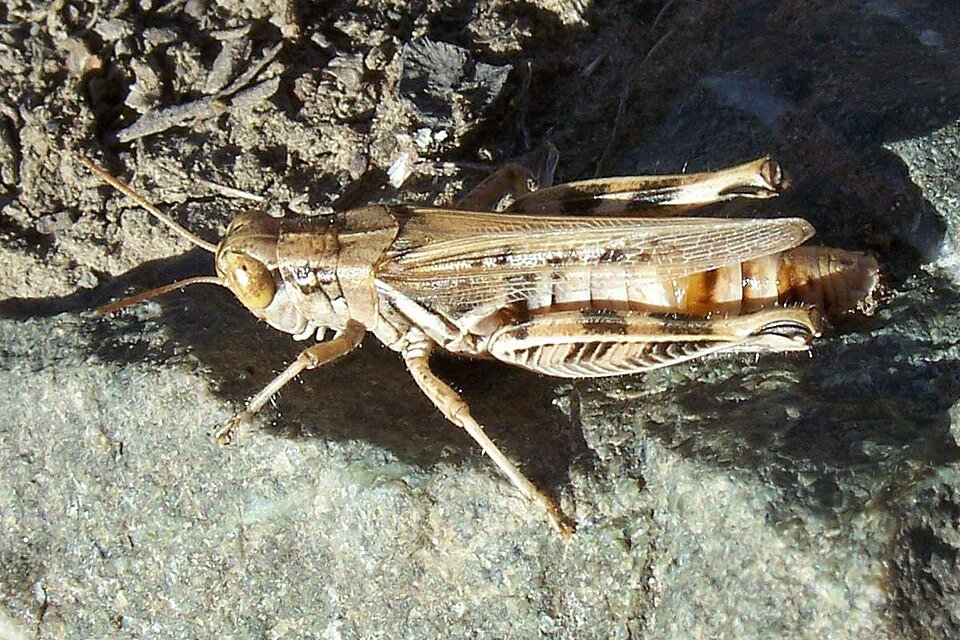
The devastating grasshopper is a grasshopper from North America. It has short feelers and strong back legs for big jumps. Its name sounds scary, but it is just a hungry plant eater.
Lives in
North America, in grassy places
Can it hurt you?
Harmless
Harmless to people. It may kick with its strong back legs if you hold it.
What does it eat?
Like other grasshoppers, it munches on plants and grasses.
How fast is it?
A person walking about 5 km/h (3.1 mph)
Devastating grasshopper about 10 km/h (6.2 mph)
A kid running fast about 13 km/h (8.1 mph)
A grown-up on a bike about 25 km/h (16 mph)
cool stuff
Fun facts
1
It is a spur-throated grasshopper. These grasshoppers have a little spike under their throat, between the front legs.
2
There are three slightly different kinds of it, called subspecies.
3
It was named by the American scientist Samuel Scudder in 1878.
you asked
Most asked questions about Devastating grasshopper
?Is the devastating grasshopper dangerous?
No. It is harmless to people and only eats plants.
?What does the devastating grasshopper eat?
Plants and grasses, like other grasshoppers.
For bug experts
- Scientific name
- Melanoplus devastator
- Named by
- Scudder, 1878
- Group
- Grasshoppers and crickets
- Family
- Acrididae
- Classification
- Insecta > Orthoptera > Acrididae
- Lives on
- North America
Where the facts come from
- Melanoplus devastator (Wikipedia, CC BY-SA 4.0): what it looks like, where it lives, what it eats, sizes and fun facts, retold in simple words.
- Picture by Eugene Zelenko. CC BY-SA 4.0, Wikimedia Commons. The sticker of this bug is drawn from this picture.
If we got something wrong, sorry, we are bug fans, not a science journal. Tell us at [email protected] and we will fix it.
Bug Wiki honey jar For grown-ups: Bug Wiki is free, with no ads and no tracking. A small tip helps keep it online.Leave a tip Desert locust
 House cricket
 Parktown prawn
 Eastern lubber grasshopper
 Australian plague locust
 Mormon cricket
 Twenty-spotted ladybird
 Indian green lynx spider
 Rice stink bug
 Jagged ambush bug
 Common flower bug
 Spine-tailed earwig