
Douglas-fir tussock moth

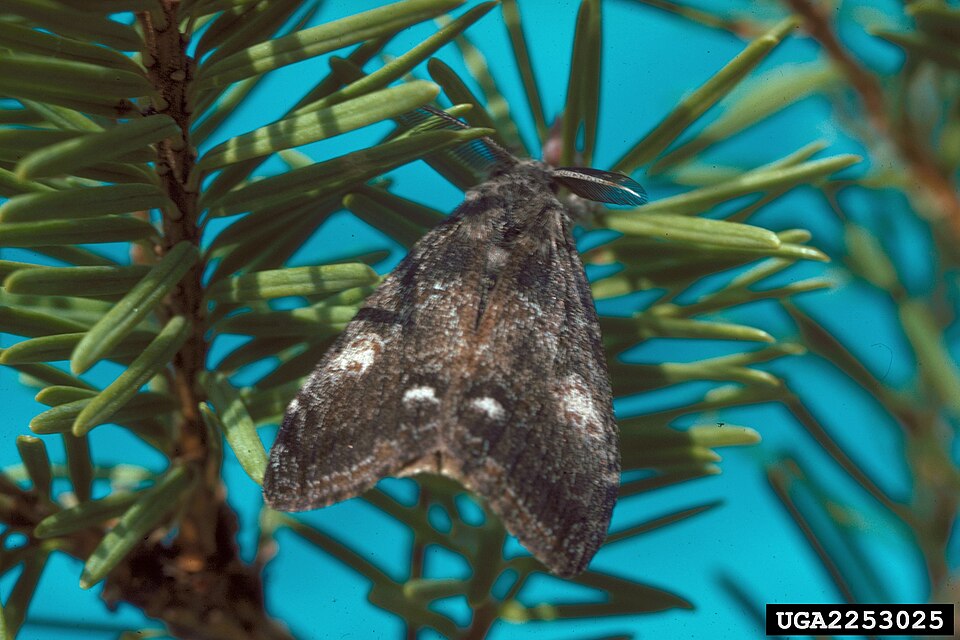
The Douglas-fir tussock moth lives in the forests of western North America. Its caterpillar is very colourful, with red spots, white tufts like little brushes and long black hairs. The grown-up female has almost no wings and cannot fly.
How big is it?
How wide are its wings?
How big is Douglas-fir tussock moth compared to YOU?
Just maths in your browser. Nothing is saved or sent anywhere.
How fast is it?
Fun facts
The caterpillars travel by hanging on long silk threads and letting the wind carry them.
The female stays right next to her cocoon, so new caterpillars hatch where she lived.
Every 8 to 12 years there are suddenly huge numbers of them.
The male has feathery feelers to smell the female.
Most asked questions about Douglas-fir tussock moth
?Can the Douglas-fir tussock moth fly?
Only the male can. The female has only tiny wings and stays near her cocoon.
?What does the Douglas-fir tussock moth eat?
Its caterpillars eat the needles of fir and spruce trees.
For bug experts
- Scientific name
- Orgyia pseudotsugata
- Named by
- McDunnough, 1921
- Group
- Moths
- Family
- Erebidae
- Classification
- Insecta > Lepidoptera > Erebidae
- Lives on
- North America
Where the facts come from
- Orgyia pseudotsugata (Wikipedia, CC BY-SA 4.0): what it looks like, where it lives, what it eats, sizes and fun facts, retold in simple words.
- Picture by Jerald E. Dewey. CC BY 3.0 us, Wikimedia Commons. The sticker of this bug is drawn from this picture.
If we got something wrong, sorry, we are bug fans, not a science journal. Tell us at [email protected] and we will fix it.
Bug Wiki honey jar For grown-ups: Bug Wiki is free, with no ads and no tracking. A small tip helps keep it online.Leave a tip Atlas moth
 Luna moth
 Hummingbird hawk-moth
 Domestic silk moth
 Isabella tiger moth
 Polyphemus moth
 End band net-winged beetle
 Narrow green-banded swallowtail
 Common pine sawfly
 Southern pine beetle
 Giant jumping ant
 Pine tree spur-throat grasshopper