
Mexican rose tarantula
Aphonopelma pallidum
Eats: Other bugs and small animalsSpidersDeserts and dry places8 legsNot an insect, but a bug cousin

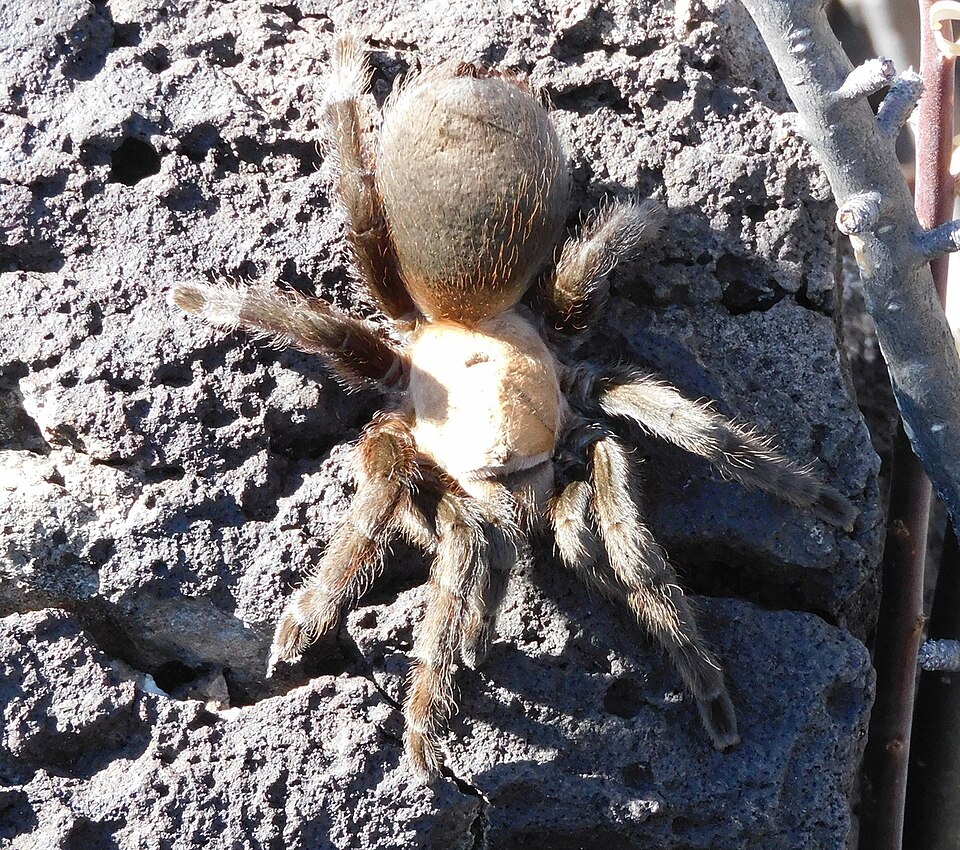
The Mexican rose tarantula is a big hairy spider from Mexico. The grown-up male has brown legs and a dull rose grey front part. That soft pinkish grey colour gave it its name.
Fun fact: spiders are not insects. Insects have six legs, spiders have eight. Everyone calls them bugs anyway!
Lives in
Mexico
Length
5 to 5.5 cm (2 to 2.2 in)
What does it eat?
Like other tarantulas, it hunts insects and other small animals.
How big is it?
How long is it?
🍚as long as 9 grains of rice in a row🧱as long as 1.5 toy building bricks in a row🍽️could run across a dinner table in 2.6 seconds
How big is Mexican rose tarantula compared to YOU?
Just maths in your browser. Nothing is saved or sent anywhere.
How fast is it?
A tortoise about 0.3 km/h (0.19 mph)
Mexican rose tarantula about 1.4 km/h (0.87 mph)
A person walking about 5 km/h (3.1 mph)
A kid running fast about 13 km/h (8.1 mph)
cool stuff
Fun facts
1
It is listed as threatened in Mexico, so it needs protecting.
2
It is not sold as a pet. For a while another tarantula was sold under its name by mistake, until that one got its own name in 2003.
3
Its body alone is about 5 centimetres long, as long as a grown-up's thumb.
you asked
Most asked questions about Mexican rose tarantula
?How big is the Mexican rose tarantula?
Its body is about 50 to 55 millimetres long, not counting the legs.
For bug experts
- Scientific name
- Aphonopelma pallidum
- Group
- Spiders
- Family
- Theraphosidae
- Classification
- Arachnida > Araneae > Theraphosidae
- Lives on
- North America
- Also known as
- Rose-grey tarantula
Where the facts come from
- Aphonopelma pallidum (Wikipedia, CC BY-SA 4.0): what it looks like, where it lives, what it eats, sizes and fun facts, retold in simple words.
- Picture by Jonathan Rodriguez. CC BY 4.0, Wikimedia Commons. The sticker of this bug is drawn from this picture.
If we got something wrong, sorry, we are bug fans, not a science journal. Tell us at [email protected] and we will fix it.
Bug Wiki honey jar For grown-ups: Bug Wiki is free, with no ads and no tracking. A small tip helps keep it online.Leave a tip European garden spider
 Goliath birdeater
 Brown recluse
 Redback spider
 Yellow garden spider
 Bold jumping spider
 Green drab
 Southern harvester termite
 Magnificent velvet ant
 Mitchell's diurnal cockroach
 Sandia hairstreak
 Texan crescent
.jpg)