
Cape rainspider
Palystes castaneus

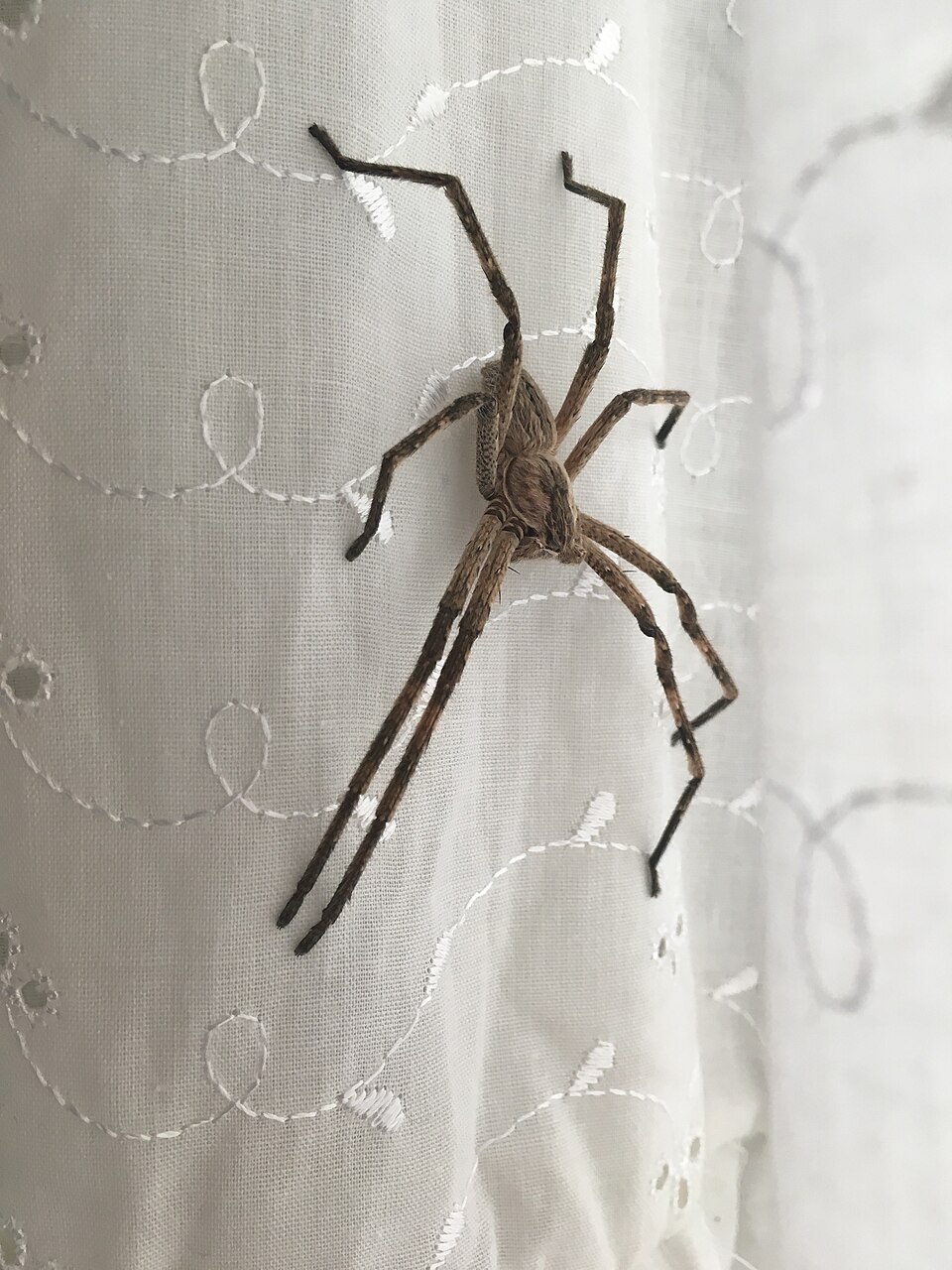
The Cape rainspider is a big huntsman spider from South Africa. It does not spin a web to catch food. It hunts on plants, and it often walks into houses just before it starts to rain.
Fun fact: spiders are not insects. Insects have six legs, spiders have eight. Everyone calls them bugs anyway!
Lives in
South Africa, Mozambique and Zimbabwe, in forests and gardens
Length
1.7 to 2.2 cm (0.67 to 0.87 in)
What does it eat?
It hunts insects on plants. Inside houses it sometimes even catches small geckos.
How big is it?
How long is it?
🍚as long as 4 grains of rice in a row🍽️could run across a dinner table in 1.3 seconds⚡moves 35 times its own body length every second
How big is Cape rainspider compared to YOU?
Just maths in your browser. Nothing is saved or sent anywhere.
How fast is it?
Cape rainspider about 2.8 km/h (1.7 mph)
A person walking about 5 km/h (3.1 mph)
A kid running fast about 13 km/h (8.1 mph)
A grown-up on a bike about 25 km/h (16 mph)
cool stuff
Fun facts
1
It often comes indoors just before rain, which is how it got its name.
2
The mother makes a round egg sac as big as an orange, with twigs and leaves woven into the silk.
3
The baby spiders hatch inside the sac and chew their way out after about three weeks.
4
A big wasp hunts this spider and drags it away to feed its baby.
you asked
Most asked questions about Cape rainspider
?Why is it called a rain spider?
Because it often comes into houses just before it rains.
For bug experts
- Scientific name
- Palystes castaneus
- Named by
- Latreille, 1819
- Group
- Spiders
- Family
- Sparassidae
- Classification
- Arachnida > Araneae > Sparassidae
- Lives on
- Africa
- Also known as
- Rain spider, Lizard-eating spider
Where the facts come from
- Palystes castaneus (Wikipedia, CC BY-SA 4.0): what it looks like, where it lives, what it eats, sizes and fun facts, retold in simple words.
- Picture by Britfan97. CC BY-SA 4.0, Wikimedia Commons. The sticker of this bug is drawn from this picture.
If we got something wrong, sorry, we are bug fans, not a science journal. Tell us at [email protected] and we will fix it.
Bug Wiki honey jar For grown-ups: Bug Wiki is free, with no ads and no tracking. A small tip helps keep it online.Leave a tip European garden spider
 Goliath birdeater
 Brown recluse
 Redback spider
 Yellow garden spider
 Bold jumping spider
 Carolina pine sawyer
 White-barred emperor
 Margined carrion beetle
 Nut-tree tussock
 Tissue
 Variable diadem