
Brindled beauty moth
Lycia hirtaria

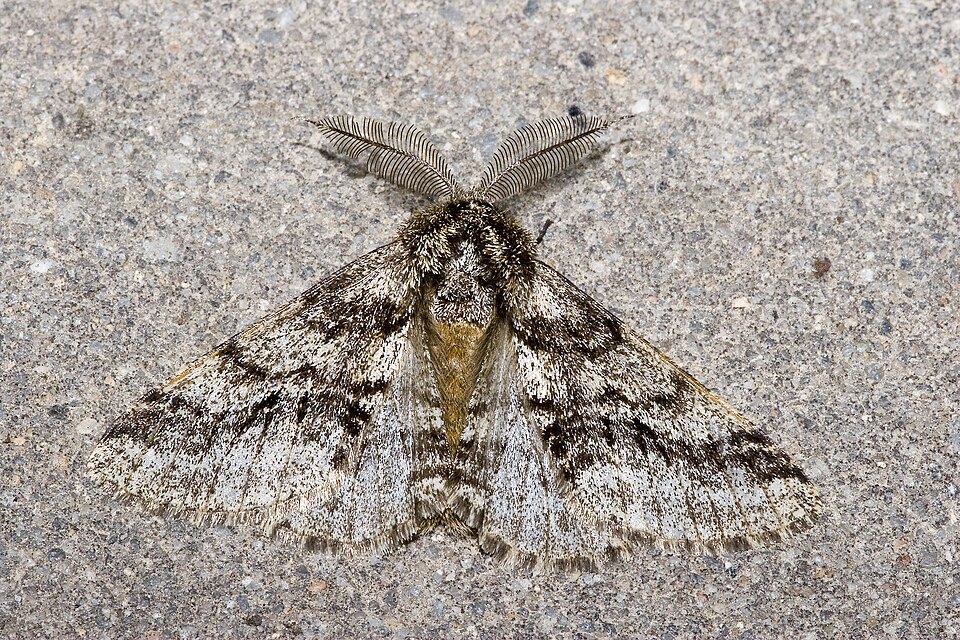
The brindled beauty is a big, furry moth with grey wings dusted in black. When it sits on a tree trunk, its pattern makes it almost impossible to see. It flies in early spring, when many other moths are still asleep.
Lives in
Most of Europe and across Asia to Japan, in woods and leafy suburbs
Wingspan
4 to 5 cm (1.6 to 2 in)
Can it hurt you?
Harmless
Harmless. It cannot bite or sting.
What does it eat?
Its caterpillars eat the leaves of many trees and bushes, like birch, oak, willow, apple and roses.
How big is it?
How wide are its wings?
🧱wings as wide as 1.5 toy building bricks⚽could fly across a whole football pitch in 24 seconds
How big is Brindled beauty moth compared to YOU?
Just maths in your browser. Nothing is saved or sent anywhere.
How fast is it?
A kid running fast about 13 km/h (8.1 mph)
Brindled beauty moth about 16 km/h (9.9 mph)
A grown-up on a bike about 25 km/h (16 mph)
A car driving in town about 50 km/h (31 mph)
cool stuff
Fun facts
1
The males have big feelers shaped like combs.
2
The females have a pale yellow wash over their wings.
3
The moths fly from March to the end of May, and the males come to lights.
4
It spends the winter as a pupa.
you asked
Most asked questions about Brindled beauty moth
?What does the brindled beauty eat?
Its caterpillars eat leaves of many trees and bushes, such as birch, oak, willow and apple.
?When does the brindled beauty fly?
In spring, from March to the end of May.
For bug experts
- Scientific name
- Lycia hirtaria
- Named by
- Clerck, 1760
- Group
- Moths
- Family
- Geometridae
- Classification
- Insecta > Lepidoptera > Geometridae
- Lives on
- Europe, Asia
- Also known as
- Brindled beauty
Where the facts come from
- Brindled beauty (Wikipedia, CC BY-SA 4.0): what it looks like, where it lives, what it eats, sizes and fun facts, retold in simple words.
- Picture by Olei. CC BY-SA 3.0, Wikimedia Commons. The sticker of this bug is drawn from this picture.
If we got something wrong, sorry, we are bug fans, not a science journal. Tell us at [email protected] and we will fix it.
Bug Wiki honey jar For grown-ups: Bug Wiki is free, with no ads and no tracking. A small tip helps keep it online.Leave a tip Atlas moth
 Luna moth
 Hummingbird hawk-moth
 Domestic silk moth
 Isabella tiger moth
 Polyphemus moth
 Silver-green leaf weevil
 Lebbek borer
 Pea gall wasp
 Weidemeyer's admiral
 Small yellow cockroach
 Swordgrass brown