
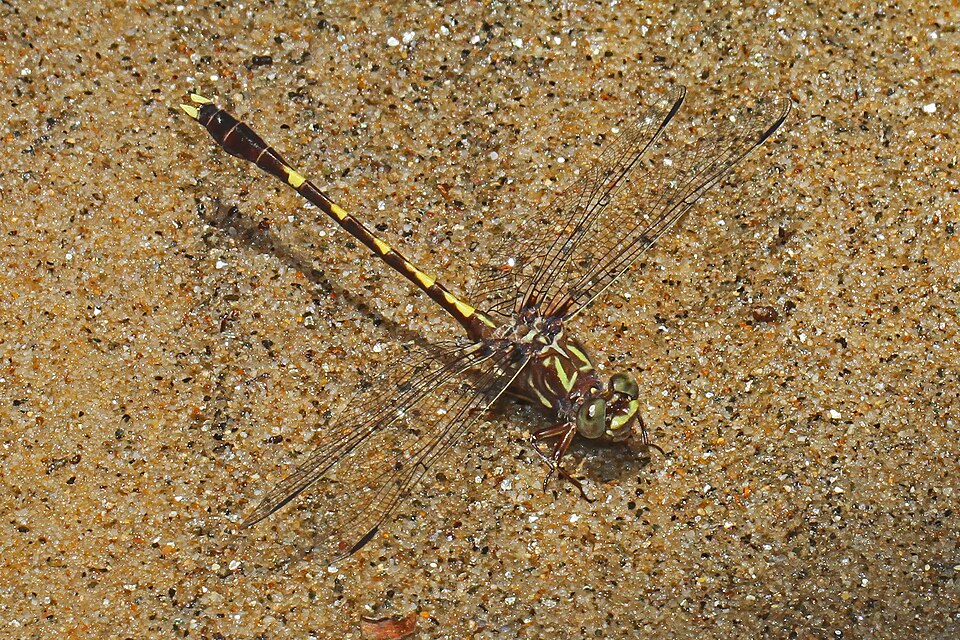
Common sanddragon
Progomphus obscurus

The common sanddragon is a dragonfly. It belongs to the clubtails, a family of dragonflies whose tail is often wider near the end. It zooms over the water hunting for small insects.
Lives in
The eastern United States and southern Ontario in Canada, near water
Can it hurt you?
Harmless
Harmless. Dragonflies have no sting and are no danger to people.
What does it eat?
Like all dragonflies, it catches small flying insects. Its young live in the water and hunt tiny water animals.
How fast is it?
A kid running fast about 13 km/h (8.1 mph)
A grown-up on a bike about 25 km/h (16 mph)
Common sanddragon about 40 km/h (25 mph)
A car driving in town about 50 km/h (31 mph)
cool stuff
Fun facts
1
It is one of the clubtail dragonflies, the family called Gomphidae.
2
It lives in the eastern United States and also reaches southern Ontario in Canada.
3
Like every dragonfly, it starts life in the water as a nymph before it climbs out and gets wings.
you asked
Most asked questions about Common sanddragon
?Does the common sanddragon sting?
No. Dragonflies have no sting and are harmless to people.
?Where does the common sanddragon live?
In the eastern United States and southern Ontario, Canada.
For bug experts
- Scientific name
- Progomphus obscurus
- Group
- Dragonflies and damselflies
- Family
- Gomphidae
- Classification
- Insecta > Odonata > Gomphidae
- Lives on
- North America
Where the facts come from
- Progomphus obscurus (Wikipedia, CC BY-SA 4.0): what it looks like, where it lives, what it eats, sizes and fun facts, retold in simple words.
- Picture by Judy Gallagher. CC BY 2.0, Wikimedia Commons. The sticker of this bug is drawn from this picture.
If we got something wrong, sorry, we are bug fans, not a science journal. Tell us at [email protected] and we will fix it.
Bug Wiki honey jar For grown-ups: Bug Wiki is free, with no ads and no tracking. A small tip helps keep it online.Leave a tip Emperor dragonfly
 Common whitetail
 Green darner
 Ebony jewelwing
 Globe skimmer
 Blue dasher
 Palamedes swallowtail
 Drake mackerel
 Brown waterscorpion
 Shore spider
 Fringed diving beetle
 Short-tailed swallowtail