
Double-banded carpenter bee
Xylocopa caffra

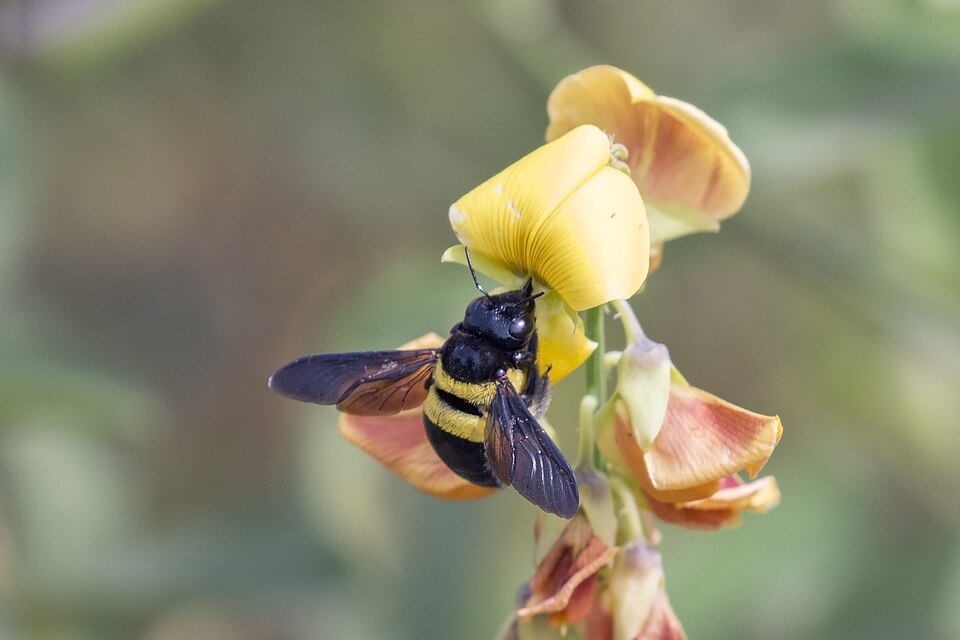
The double-banded carpenter bee is a big African bee. The female is black with two white or yellow bands, but the male is greenish yellow all over. It makes its nest by chewing holes in wood and plant stems.
Lives in
Much of Africa, Madagascar and islands in the Indian Ocean
What does it eat?
It drinks nectar and collects pollen from lots of different plants. Its babies eat a mix of pollen and nectar that the mother leaves for them.
How fast is it?
A kid running fast about 13 km/h (8.1 mph)
Double-banded carpenter bee about 22 km/h (14 mph)
A grown-up on a bike about 25 km/h (16 mph)
A car driving in town about 50 km/h (31 mph)
cool stuff
Fun facts
1
The female nests alone inside aloe stems, tree branches or old wood.
2
Inside the nest she makes little rooms with walls made of glued wood crumbs.
3
She carries tiny helper mites in a special pocket on her body. The mites eat mould that could spoil her babies' food.
4
The males guard small areas around certain flowers and chase other bees away.
you asked
Most asked questions about Double-banded carpenter bee
?Why is it called a carpenter bee?
Because it makes its nest by chewing holes in wood, like a little carpenter.
For bug experts
- Scientific name
- Xylocopa caffra
- Named by
- Linnaeus, 1767
- Group
- Bees and bumblebees
- Family
- Apidae
- Classification
- Insecta > Hymenoptera > Apidae
- Lives on
- Africa
Where the facts come from
- Xylocopa caffra (Wikipedia, CC BY-SA 4.0): what it looks like, where it lives, what it eats, sizes and fun facts, retold in simple words.
- Picture by Charles J. Sharp. CC BY-SA 4.0, Wikimedia Commons. The sticker of this bug is drawn from this picture.
If we got something wrong, sorry, we are bug fans, not a science journal. Tell us at [email protected] and we will fix it.
Bug Wiki honey jar For grown-ups: Bug Wiki is free, with no ads and no tracking. A small tip helps keep it online.Leave a tip Western honey bee
 Buff-tailed bumblebee
 Violet carpenter bee
 Giant honey bee
 Wallace's giant bee
 Himalayan giant honey bee
 Black-veined moth
 Sweet potato bug
 Hypericum rhopalid
 Orange-spotted flower moth
 Cottonwood stag beetle
 Formosan swift
.jpg)