
Peregrine stone centipede
Lithobius peregrinus
Eats: Other bugs and small animalsCentipedes and millipedesGardens and meadowsNot an insect, but a bug cousin

The peregrine stone centipede is a small, quick centipede that lives in soil and fallen leaves. It hunts alone, scurrying about after tiny creatures. It has travelled so far that it now lives all around the world.
Fun fact: this one is not an insect. Insects have six legs, and this cousin has many, many more.
Lives in
All around the world, in soil and leaf litter. It was first found in Croatia
What does it eat?
It is a hunter and catches tiny animals in the soil and leaf litter.
How fast is it?
A tortoise about 0.3 km/h (0.19 mph)
Peregrine stone centipede about 1.5 km/h (0.93 mph)
A person walking about 5 km/h (3.1 mph)
A kid running fast about 13 km/h (8.1 mph)
cool stuff
Fun facts
1
Its name peregrinus means wanderer, a good name for a centipede found all over the world.
2
It was first described in 1880 by an Austrian scientist named Robert Latzel.
3
The very first one described came from Dalmatia, on the coast of Croatia.
you asked
Most asked questions about Peregrine stone centipede
?Where does the peregrine stone centipede live?
All around the world, in soil and under fallen leaves.
For bug experts
- Scientific name
- Lithobius peregrinus
- Named by
- Latzel, 1880
- Group
- Centipedes and millipedes
- Family
- Lithobiidae
- Classification
- Chilopoda > Lithobiomorpha > Lithobiidae
- Lives on
- Europe, Asia, Africa, North America, South America, Australia and Oceania
Where the facts come from
- Lithobius peregrinus (Wikipedia, CC BY-SA 4.0): what it looks like, where it lives, what it eats, sizes and fun facts, retold in simple words.
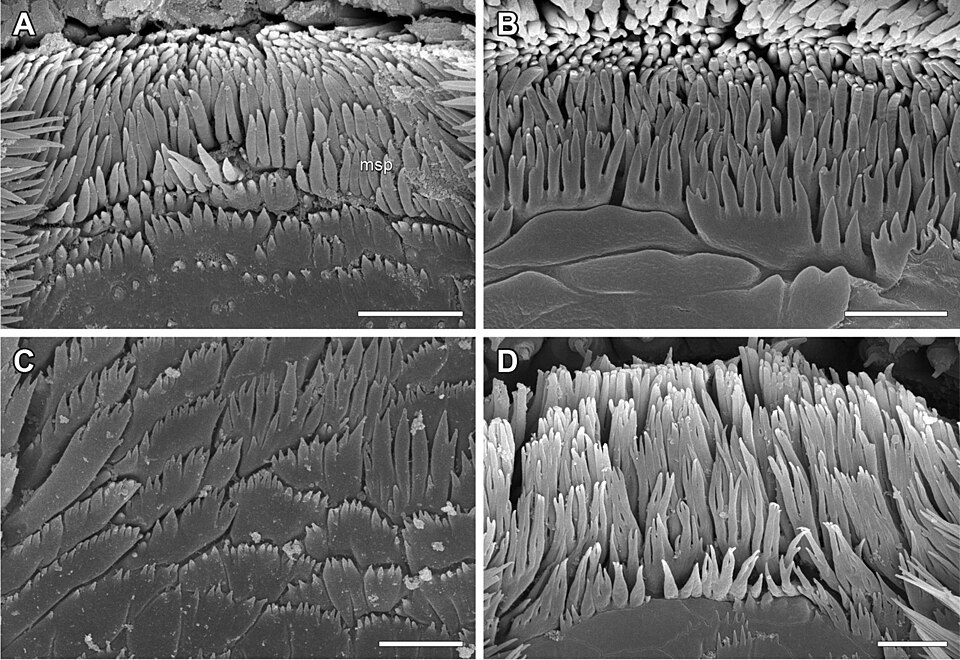
- Picture by Ganske A-S, Edgecombe GD, Akkari N (2018) The peristomatic structures as a source of systematic characters in the genus Lithobius Leach, 1814 (Myriapoda, Chilop. CC BY 4.0, Wikimedia Commons. The sticker of this bug is drawn from this picture.
If we got something wrong, sorry, we are bug fans, not a science journal. Tell us at [email protected] and we will fix it.
Bug Wiki honey jar For grown-ups: Bug Wiki is free, with no ads and no tracking. A small tip helps keep it online.Leave a tip Giant African millipede
 House centipede
 Amazonian giant centipede
 Vietnamese centipede
 Giant desert centipede
 Greenhouse millipede
 Tailed jay
 Shamrock spider
 Red earthworm
 Pennsylvania grass spider
 Meadow brown
 Fig wasp
_Figure_6.jpg)