
Puerto Rican pinktoe tarantula
Caribena laeta
Eats: Other bugs and small animalsSpidersRainforests and jungles8 legsNot an insect, but a bug cousin

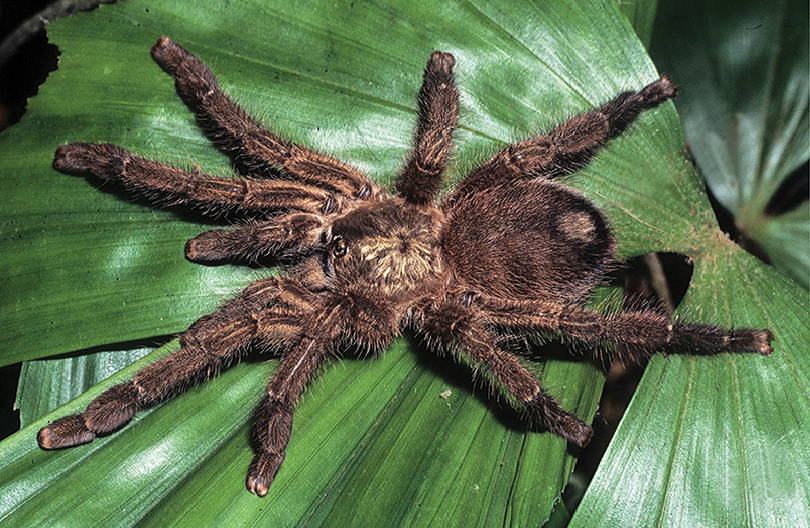
The Puerto Rican pinktoe tarantula is a hairy spider that lives up in the trees of warm Caribbean islands. It is light brown, and the tips of its legs shimmer metallic blue or green. It is gentle but very jumpy, and it spins lots of silk.
Fun fact: spiders are not insects. Insects have six legs, spiders have eight. Everyone calls them bugs anyway!
Lives in
Puerto Rico and the US Virgin Islands, maybe Cuba, in warm tropical places
What does it eat?
Like other tarantulas, it hunts insects and other small animals.
How fast is it?
A tortoise about 0.3 km/h (0.19 mph)
Puerto Rican pinktoe tarantula about 1.5 km/h (0.93 mph)
A person walking about 5 km/h (3.1 mph)
A kid running fast about 13 km/h (8.1 mph)
cool stuff
Fun facts
1
Females can live 10 to 12 years, but males only live 3 to 4 years.
2
It lives in trees, not in a burrow on the ground.
3
When it feels scared, it lifts its legs in a warning pose and you can see the shiny blue or green tips.
4
It has a patch of itchy hairs on its back end that it can flick, but it very rarely does.
you asked
Most asked questions about Puerto Rican pinktoe tarantula
?How long does a Puerto Rican pinktoe tarantula live?
Females live about 10 to 12 years and males about 3 to 4 years.
For bug experts
- Scientific name
- Caribena laeta
- Named by
- Koch, 1842
- Group
- Spiders
- Family
- Theraphosidae
- Classification
- Arachnida > Araneae > Theraphosidae
- Lives on
- North America
Where the facts come from
- Caribena laeta (Wikipedia, CC BY-SA 4.0): what it looks like, where it lives, what it eats, sizes and fun facts, retold in simple words.
- Picture by original: R. C. West processing: P. Coxhead. CC BY 3.0, Wikimedia Commons. The sticker of this bug is drawn from this picture.
If we got something wrong, sorry, we are bug fans, not a science journal. Tell us at [email protected] and we will fix it.
Bug Wiki honey jar For grown-ups: Bug Wiki is free, with no ads and no tracking. A small tip helps keep it online.Leave a tip European garden spider
 Goliath birdeater
 Brown recluse
 Redback spider
 Yellow garden spider
 Bold jumping spider
 Cynosura eighty-eight
 Banyan tussock moth
 Southern red rim
 Pale owl-butterfly
 Blue-spotted crow butterfly
 Malayan eggfly