
Blue bush dart

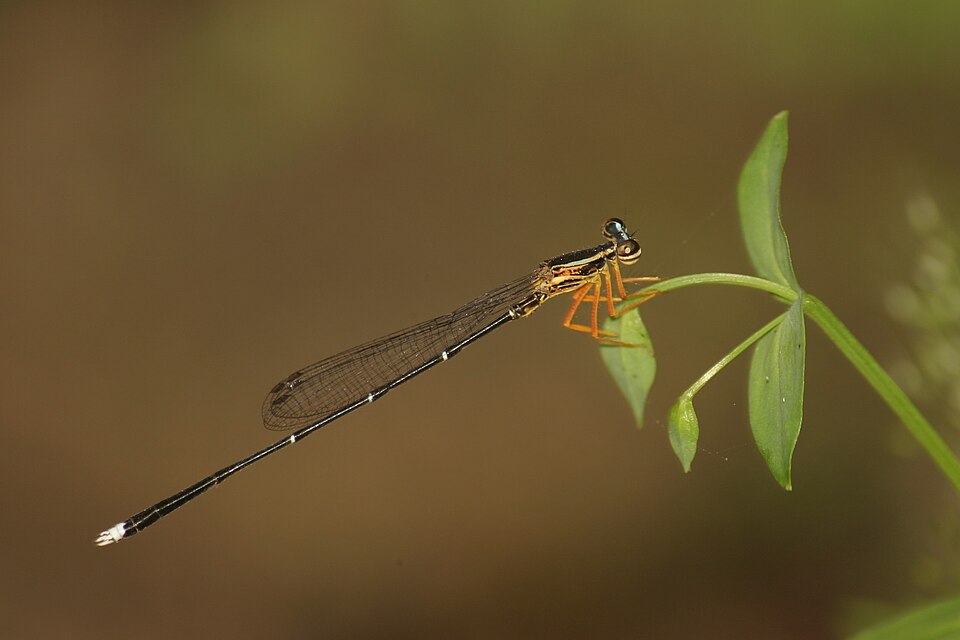
The blue bush dart is a slim damselfly that hides among the plants along rivers and streams. It has yellow eyes with a brown cap and a thin black belt around them. The tip of its long tail is a pale bluish white.
How fast is it?
Fun facts
Its long body is black on top with little bluish white rings.
The female is a bit chunkier than the male and has duller colours.
Right after it comes out of its old skin, a young one can be almost all white with just a few black marks.
Scientists think it might really be several very similar kinds of damselfly.
Most asked questions about Blue bush dart
?Where does the blue bush dart live?
In Asia, from India to Indonesia, among the plants along rivers and streams.
?Is the blue bush dart dangerous?
No. Damselflies have no sting and are harmless to people.
For bug experts
- Scientific name
- Copera vittata
- Group
- Dragonflies and damselflies
- Family
- Platycnemididae
- Classification
- Insecta > Odonata > Platycnemididae
- Lives on
- Asia
Where the facts come from
- Copera vittata (Wikipedia, CC BY-SA 4.0): what it looks like, where it lives, what it eats, sizes and fun facts, retold in simple words.
- Picture by Davidvraju. CC BY-SA 4.0, Wikimedia Commons. The sticker of this bug is drawn from this picture.
If we got something wrong, sorry, we are bug fans, not a science journal. Tell us at [email protected] and we will fix it.
Bug Wiki honey jar For grown-ups: Bug Wiki is free, with no ads and no tracking. A small tip helps keep it online.Leave a tip Emperor dragonfly
 Common whitetail
 Green darner
 Ebony jewelwing
 Globe skimmer
 Blue dasher
 Australasian giant water bug
 Shoreline wolf spider
 Northern bear spider
 Salvinia stem borer moth
 Common sea skater
 Cattail mosquito