
Australian marine slater
Ligia australiensis
Eats: Leftovers and dead thingsWoodlicePonds, rivers and shores14 legsNot an insect, but a bug cousin

The Australian marine slater is a woodlouse that lives at the seashore. It hides under rocks, wood and all sorts of other cover along the coast. Like other woodlice, it is a cousin of crabs and shrimps.
Fun fact: woodlice are not insects. They are crustaceans, cousins of crabs and shrimps, that live on land.
Lives in
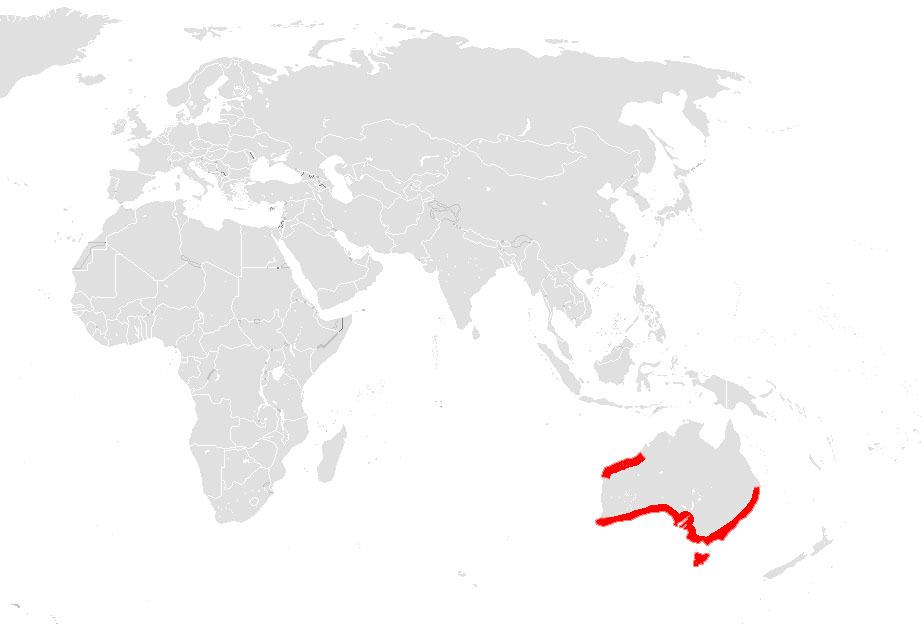
The southern coast of Australia and Tasmania, on rocky shores and in river mouths
Can it hurt you?
Harmless
Harmless. It cannot bite or sting.
What does it eat?
Like other sea slaters, it eats seaweed and bits of dead plants and animals washed up on the shore.
How fast is it?
A garden snail about 0.05 km/h (0.03 mph)
Australian marine slater about 0.15 km/h (0.09 mph)
A tortoise about 0.3 km/h (0.19 mph)
A person walking about 5 km/h (3.1 mph)
cool stuff
Fun facts
1
It is a favourite meal of the burrowing shore crab.
2
Sometimes the sacred kingfisher, a bird, catches it too.
3
On the coast of New South Wales it is less common, but there can be lots of them where rivers meet the sea.
you asked
Most asked questions about Australian marine slater
?Where does the Australian marine slater live?
Along the southern coast of Australia and in Tasmania, hiding under cover on the shore.
?What eats the Australian marine slater?
Mostly the burrowing shore crab, and sometimes the sacred kingfisher.
For bug experts
- Scientific name
- Ligia australiensis
- Group
- Woodlice
- Family
- Ligiidae
- Classification
- Malacostraca > Isopoda > Ligiidae
- Lives on
- Australia and Oceania
Where the facts come from
- Ligia australiensis (Wikipedia, CC BY-SA 4.0): what it looks like, where it lives, what it eats, sizes and fun facts, retold in simple words.
- Picture by MatthewMMcM. CC BY-SA 3.0, Wikimedia Commons. The sticker of this bug is drawn from this picture.
If we got something wrong, sorry, we are bug fans, not a science journal. Tell us at [email protected] and we will fix it.
Bug Wiki honey jar For grown-ups: Bug Wiki is free, with no ads and no tracking. A small tip helps keep it online.Leave a tip Common pill bug
 Tongue-eating louse
 Giant isopod
 Sea slater
 Common rough woodlouse
 Wharf roach
 Eastern toe-biter
 Norfolk hawker
 Fringed diving beetle
 Short-tailed swallowtail
 Cattail mosquito
 Willow leaf beetle