
Pale-saddled leucozona
Leucozona glaucia

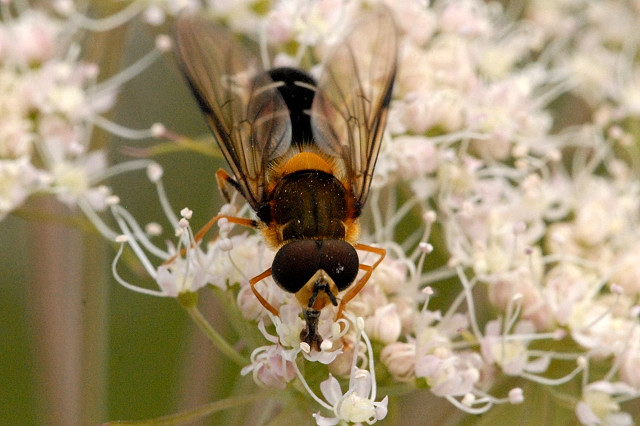
The pale-saddled leucozona is a hoverfly with big silvery-white patches near the top of its tummy, like a pale saddle. It hangs in the air over flowers, almost without moving. Its young are a gardener's helpers.
Lives in
Europe and northern Asia all the way to Japan, in woods and clearings
Can it hurt you?
Harmless
Harmless. Hoverflies cannot bite or sting.
What does it eat?
The grown-ups visit flowers such as elder, meadowsweet and ragwort. The larvae eat aphids that live low down near the ground.
How fast is it?
A person walking about 5 km/h (3.1 mph)
A kid running fast about 13 km/h (8.1 mph)
Pale-saddled leucozona about 14 km/h (8.7 mph)
A grown-up on a bike about 25 km/h (16 mph)
cool stuff
Fun facts
1
Its larvae hunt aphids, the tiny bugs that suck juice from plants.
2
It flies from May to September, and most of all in July and August.
3
Each of its wings is about 8 to 11 millimetres long.
4
It likes woods of oak and beech, riversides with willows, and sunny forest paths.
you asked
Most asked questions about Pale-saddled leucozona
?Is the pale-saddled leucozona a bee or a fly?
It is a fly called a hoverfly. It cannot sting.
?What does the pale-saddled leucozona eat?
The grown-ups visit flowers, and the larvae eat aphids.
For bug experts
- Scientific name
- Leucozona glaucia
- Group
- Flies and mosquitoes
- Family
- Syrphidae
- Classification
- Insecta > Diptera > Syrphidae
- Lives on
- Europe, Asia
Where the facts come from
- Leucozona glaucia (Wikipedia, CC BY-SA 4.0): what it looks like, where it lives, what it eats, sizes and fun facts, retold in simple words.
- Picture by James K. Lindsey. CC BY-SA 3.0, Wikimedia Commons. The sticker of this bug is drawn from this picture.
If we got something wrong, sorry, we are bug fans, not a science journal. Tell us at [email protected] and we will fix it.
Bug Wiki honey jar For grown-ups: Bug Wiki is free, with no ads and no tracking. A small tip helps keep it online.Leave a tip Housefly
 New World screwworm fly
 Lovebug
 Tsetse fly
 Common fruit fly
 Asian tiger mosquito
 Japanese termite
 Copse snail
 Synchronous firefly
 Clifden nonpareil
 Common spangle gall wasp
 Birch sawfly