
Spotted sulphur
Emmelia trabealis

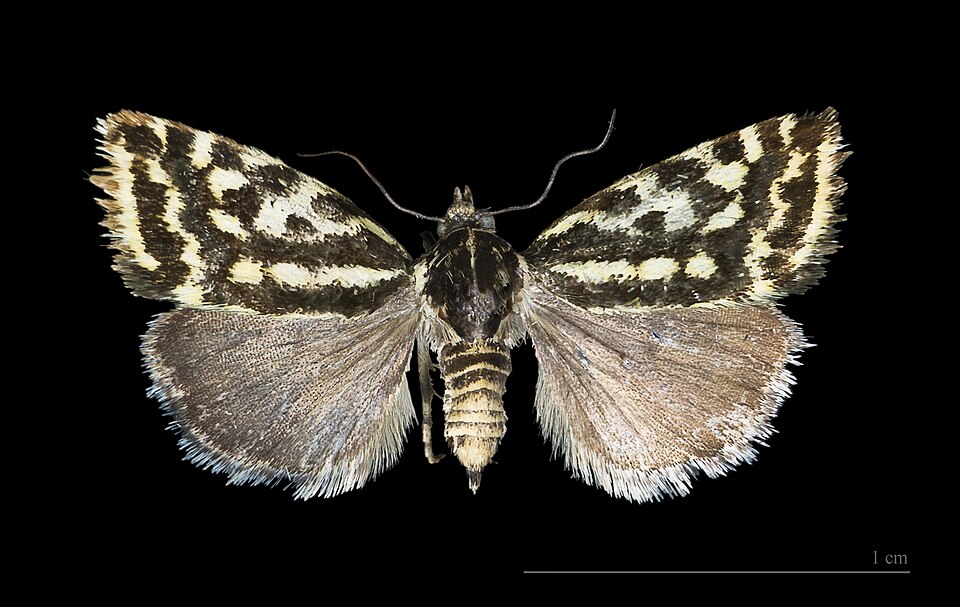
The spotted sulphur is a small moth with pale yellow front wings covered in black spots and streaks. Its back wings are reddish brown. It flies in sunshine, close to the ground, in short jerky hops.
Lives in
Most of Europe, North Africa, the Middle East and across Russia to China and Japan, on dry, sandy, sunny slopes
Wingspan
1.8 to 2.4 cm (0.71 to 0.94 in)
Can it hurt you?
Harmless
Harmless. It cannot bite or sting.
What does it eat?
Its caterpillars eat field bindweed and knotweeds.
How big is it?
How wide are its wings?
🍚wings as wide as 4 grains of rice in a row⚽could fly across a whole football pitch in 34 seconds
How big is Spotted sulphur compared to YOU?
Just maths in your browser. Nothing is saved or sent anywhere.
How fast is it?
A person walking about 5 km/h (3.1 mph)
Spotted sulphur about 11 km/h (6.8 mph)
A kid running fast about 13 km/h (8.1 mph)
A grown-up on a bike about 25 km/h (16 mph)
cool stuff
Fun facts
1
It once lived in Great Britain, but nobody has seen it there since 1960.
2
Females usually have more yellow, and males more black.
3
Its eggs are green and shaped like tiny ribbed cones.
4
It spends the winter as a pupa and comes out as a moth in late spring.
you asked
Most asked questions about Spotted sulphur
?What does the spotted sulphur eat?
Its caterpillars eat field bindweed and knotweeds.
?When does the spotted sulphur fly?
From May to early September, in the daytime when it is sunny.
For bug experts
- Scientific name
- Emmelia trabealis
- Named by
- Scopoli, 1763
- Group
- Moths
- Family
- Noctuidae
- Classification
- Insecta > Lepidoptera > Noctuidae
- Lives on
- Europe, Africa, Asia
Where the facts come from
- Emmelia trabealis (Wikipedia, CC BY-SA 4.0): what it looks like, where it lives, what it eats, sizes and fun facts, retold in simple words.
- Picture by Didier Descouens. CC BY-SA 3.0, Wikimedia Commons. The sticker of this bug is drawn from this picture.
If we got something wrong, sorry, we are bug fans, not a science journal. Tell us at [email protected] and we will fix it.
Bug Wiki honey jar For grown-ups: Bug Wiki is free, with no ads and no tracking. A small tip helps keep it online.Leave a tip Atlas moth
 Luna moth
 Hummingbird hawk-moth
 Domestic silk moth
 Isabella tiger moth
 Polyphemus moth
 Common whipspider
 California swollenstinger scorpion
 Banded scarlet tip
 Rio Grande gold tarantula
 Jericho scorpion
 Woolly darkling beetle
_trabealis_MHNT_dos.jpg)