
Bennett's laceweaver
Callobius bennetti

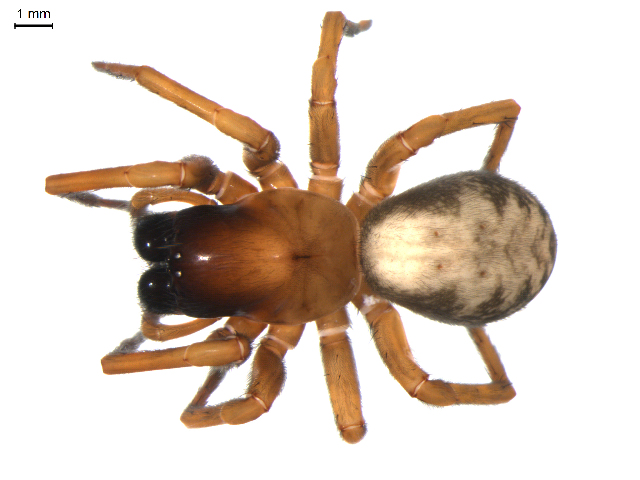
Bennett's laceweaver is a North American spider with a reddish-brown front and legs. Its round back part is grey with pale markings. It has so many names that it is called a night spider, a mesh weaver and a tangled nest spider too.
Fun fact: spiders are not insects. Insects have six legs, spiders have eight. Everyone calls them bugs anyway!
Lives in
North America
What does it eat?
Like all spiders, it catches small insects and other little creatures.
How fast is it?
A tortoise about 0.3 km/h (0.19 mph)
Bennett's laceweaver about 1.2 km/h (0.75 mph)
A person walking about 5 km/h (3.1 mph)
A kid running fast about 13 km/h (8.1 mph)
cool stuff
Fun facts
1
It has at least four other names, including night spider and tangled nest spider.
2
People sometimes mix it up with another spider called the hobo spider.
3
Like every spider, it has eight legs and is not an insect.
you asked
Most asked questions about Bennett's laceweaver
?What does Bennett's laceweaver look like?
It has a reddish-brown front and legs and a grey back part with light markings.
For bug experts
- Scientific name
- Callobius bennetti
- Group
- Spiders
- Family
- Amaurobiidae
- Classification
- Arachnida > Araneae > Amaurobiidae
- Lives on
- North America
- Also known as
- Hackled mesh weaver, Hacklemesh weaver, Night spider, Tangled nest spider
Where the facts come from
- Callobius bennetti (Wikipedia, CC BY-SA 4.0): what it looks like, where it lives, what it eats, sizes and fun facts, retold in simple words.
- Picture by Gergin Blagoev. CC0, Wikimedia Commons. The sticker of this bug is drawn from this picture.
If we got something wrong, sorry, we are bug fans, not a science journal. Tell us at [email protected] and we will fix it.
Bug Wiki honey jar For grown-ups: Bug Wiki is free, with no ads and no tracking. A small tip helps keep it online.Leave a tip European garden spider
 Goliath birdeater
 Brown recluse
 Redback spider
 Yellow garden spider
 Bold jumping spider
 Black-headed bull ant
 Common quaker
 Chinese windmill
 Potter spider wasp
 Yellow-barred longhorn
 Jumping jack ant