
Coastal robust scorpion
Urodacus novaehollandiae
Eats: Other bugs and small animalsScorpions, ticks and friendsDeserts and dry places8 legsNot an insect, but a bug cousin

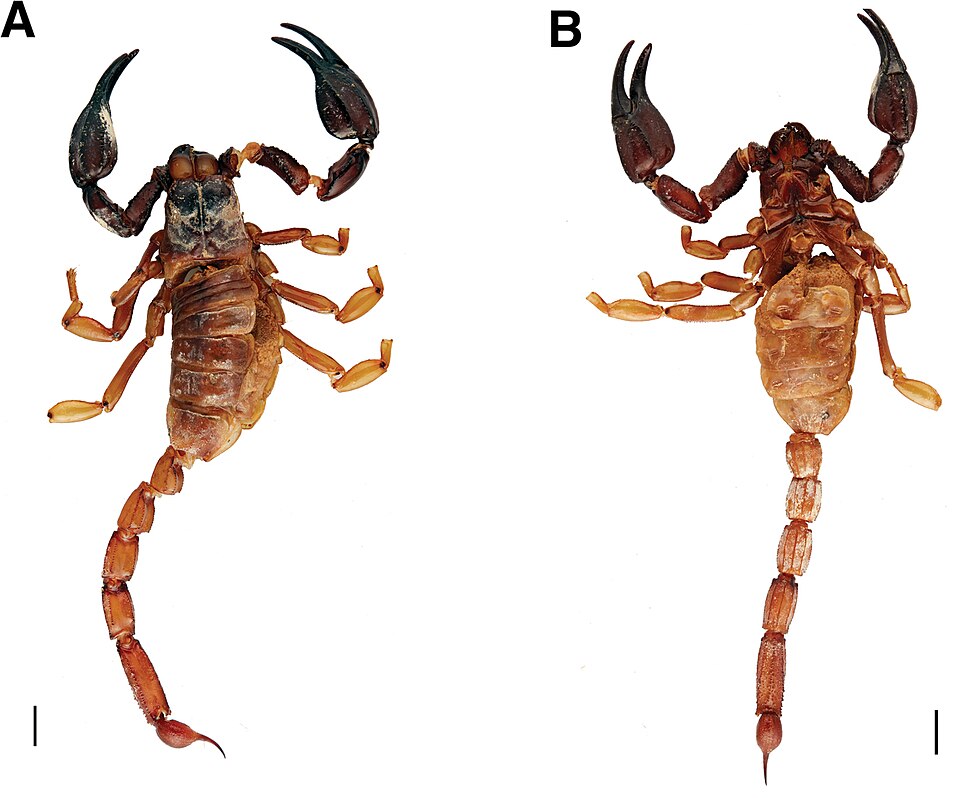
The coastal robust scorpion is a big, sturdy scorpion from southern Australia. It is yellowish brown to dark brown, with a darker head and pincers. It lives in sand dunes near the sea and digs deep burrows.
Fun fact: this one is not an insect. It is an arachnid with eight legs, a cousin of the spiders.
Lives in
Southern Australia, from Adelaide to Perth, in coastal sand dunes
Length
7 to 10 cm (2.8 to 3.9 in)
What does it eat?
It waits at night near its burrow and grabs insects and other small animals that come by.
How big is it?
How long is it?
🧱as long as 3 toy building bricks in a row✋about as long as your hand🍽️could run across a dinner table in 1.4 seconds
How big is Coastal robust scorpion compared to YOU?
Just maths in your browser. Nothing is saved or sent anywhere.
How fast is it?
A tortoise about 0.3 km/h (0.19 mph)
Coastal robust scorpion about 2.6 km/h (1.6 mph)
A person walking about 5 km/h (3.1 mph)
A kid running fast about 13 km/h (8.1 mph)
cool stuff
Fun facts
1
It digs spiral burrows up to 1 metre deep and hides in them during the day.
2
It hunts at night by waiting very still and then pouncing.
3
It can live for at least 12 years.
4
It grows to about 7 to 10 centimetres long.
you asked
Most asked questions about Coastal robust scorpion
?How big is the coastal robust scorpion?
It is about 7 to 10 centimetres long.
?How long does it live?
At least 12 years.
For bug experts
- Scientific name
- Urodacus novaehollandiae
- Named by
- Peters, 1861
- Group
- Scorpions, ticks and friends
- Family
- Urodacidae
- Classification
- Arachnida > Scorpiones > Urodacidae
- Lives on
- Australia and Oceania
- Also known as
- Coastal burrowing scorpion, Black sand scorpion
Where the facts come from
- Urodacus novaehollandiae (Wikipedia, CC BY-SA 4.0): what it looks like, where it lives, what it eats, sizes and fun facts, retold in simple words.
- Picture by Lionel Monod, Nadine Duperre, Danilo Harms. CC BY 4.0, Wikimedia Commons. The sticker of this bug is drawn from this picture.
If we got something wrong, sorry, we are bug fans, not a science journal. Tell us at [email protected] and we will fix it.
Bug Wiki honey jar For grown-ups: Bug Wiki is free, with no ads and no tracking. A small tip helps keep it online.Leave a tip Emperor scorpion
 Lone star tick
 Deathstalker
 Itch mite
 Eyelash mite
 Deer tick
 Grand antlion
 Spotted sulphur
 Inflated beetle
 Bolivian salmon pink tarantula
 Empress Leilia
 Indomitable graphic moth
_Figure_64_(cropped).jpg)