
Variable field ant

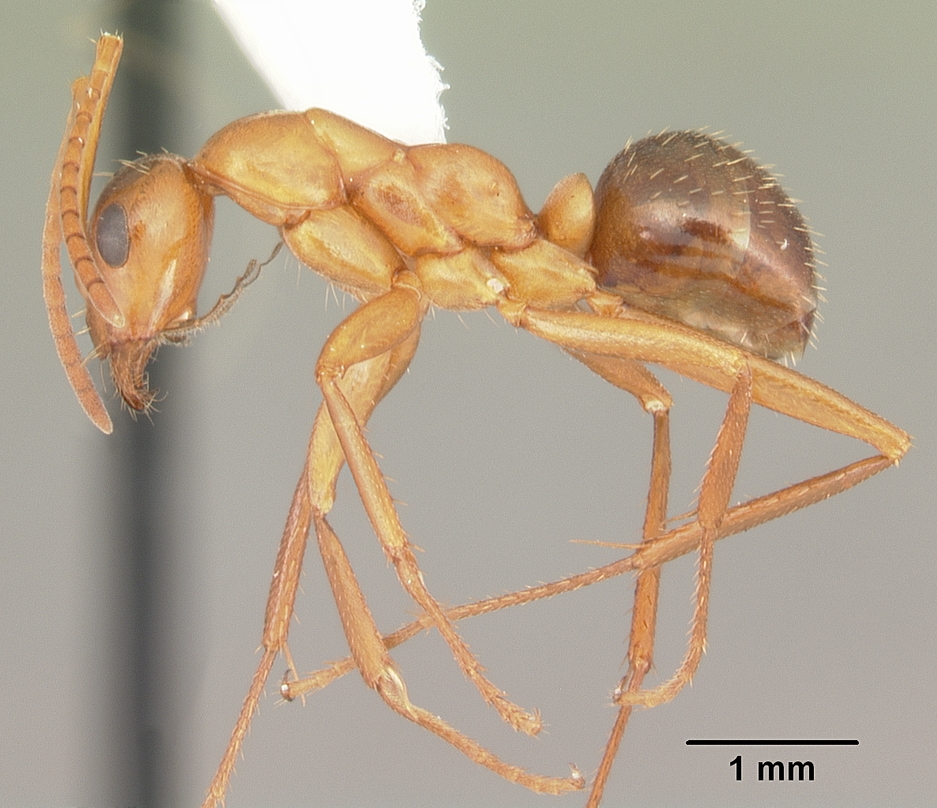
The variable field ant is a shiny ant from North America. In the north it is dark brown or almost black, but in the south it is a bright coppery yellow. It digs its home deep under the ground.
How fast is it?
Fun facts
Its nest has about 18 little rooms, each with a flat floor and a round roof.
Some tunnels in its nest go down as deep as 60 cm.
A new queen breaks off her own wings and digs a little room to lay her first eggs.
If the nest is not good any more, the whole colony can move, and the workers carry the babies to the new home.
Other ants sometimes raid its nest and steal its babies to raise them as helpers.
Most asked questions about Variable field ant
?Why is it called variable?
Because its colour varies a lot, from almost black in the north to coppery yellow in the south.
For bug experts
- Scientific name
- Formica pallidefulva
- Group
- Ants
- Family
- Formicidae
- Classification
- Insecta > Hymenoptera > Formicidae
- Lives on
- North America
Where the facts come from
- Formica pallidefulva (Wikipedia, CC BY-SA 4.0): what it looks like, where it lives, what it eats, sizes and fun facts, retold in simple words.
- Picture by April Nobile. CC BY 4.0, Wikimedia Commons. The sticker of this bug is drawn from this picture.
If we got something wrong, sorry, we are bug fans, not a science journal. Tell us at [email protected] and we will fix it.
Bug Wiki honey jar For grown-ups: Bug Wiki is free, with no ads and no tracking. A small tip helps keep it online.Leave a tip Black garden ant
 Bullet ant
 Pharaoh ant
 Argentine ant
 Red imported fire ant
 Yellow crazy ant
 Twice-stabbed stink bug
 Pollen beetle
 Hunt's bumblebee
 Heath fritillary
 Narrow-winged tree cricket
 Splay-footed carpenter