
Western black-legged tick

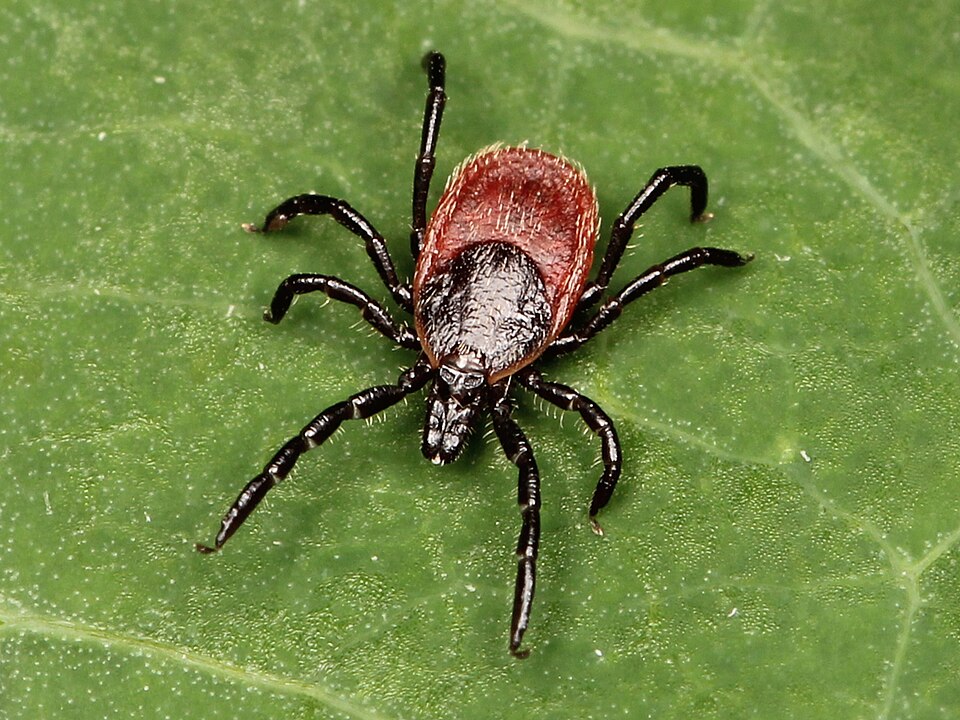
The western black-legged tick is a tiny hard tick from the west coast of North America. It waits on grass and leaves for an animal or person to walk by, then climbs on and drinks blood. It can carry Lyme disease, so it is important to check for ticks after walks.
Ticks: how to stay safe
- In Estonia, the castor bean tick and the taiga tick can carry Lyme disease and tick-borne encephalitis.
- Ticks wait on grass stems, from ankle to knee height. Long trousers tucked into socks and light clothes help you spot them.
- After playing outside, check your body, your hair and your pets for ticks.
- Found a tick? A grown-up should take it out quickly with fine tweezers or a tick tool: hold it close to the skin and pull slowly. No oil or alcohol on it. Then wash the spot.
- There is a vaccine against tick-borne encephalitis, for children too from one year old. Ask your doctor.
- If in the weeks after a bite you get a fever, feel ill or see a red patch that grows, go to a doctor.
How big is it?
How long is it?
How big is Western black-legged tick compared to YOU?
Just maths in your browser. Nothing is saved or sent anywhere.
How fast is it?
Fun facts
When a female drinks blood, she can swell up to 9.5 millimetres or more.
The young nymph is only about 2 millimetres long, so it is easy to miss.
A tick usually has to stay attached for about one and a half to two days to pass on Lyme disease, so checking for ticks every day helps a lot.
Its whole life, from egg to grown-up, takes about three years.
Most asked questions about Western black-legged tick
?Where do western black-legged ticks live?
In woods with lots of fallen leaves, in tall grass and along trails on the west coast of North America.
For bug experts
- Scientific name
- Ixodes pacificus
- Group
- Scorpions, ticks and friends
- Family
- Ixodidae
- Classification
- Arachnida > Ixodida > Ixodidae
- Lives on
- North America
Where the facts come from
- Ixodes pacificus (Wikipedia, CC BY-SA 4.0): what it looks like, where it lives, what it eats, sizes and fun facts, retold in simple words.
- Picture by Kaldari. CC0, Wikimedia Commons. The sticker of this bug is drawn from this picture.
If we got something wrong, sorry, we are bug fans, not a science journal. Tell us at [email protected] and we will fix it.
Bug Wiki honey jar For grown-ups: Bug Wiki is free, with no ads and no tracking. A small tip helps keep it online.Leave a tip Emperor scorpion
 Lone star tick
 Deathstalker
 Itch mite
 Eyelash mite
 Deer tick
 Common true katydid
 Winter moth
 Acorn weevil
 Red-legged golden orb-weaver
 Forest bug
 Pennsylvania wood cockroach