
Red spined millipede
Xenobolus carnifex
Eats: Leftovers and dead thingsCentipedes and millipedesGardens and meadowsNot an insect, but a bug cousin

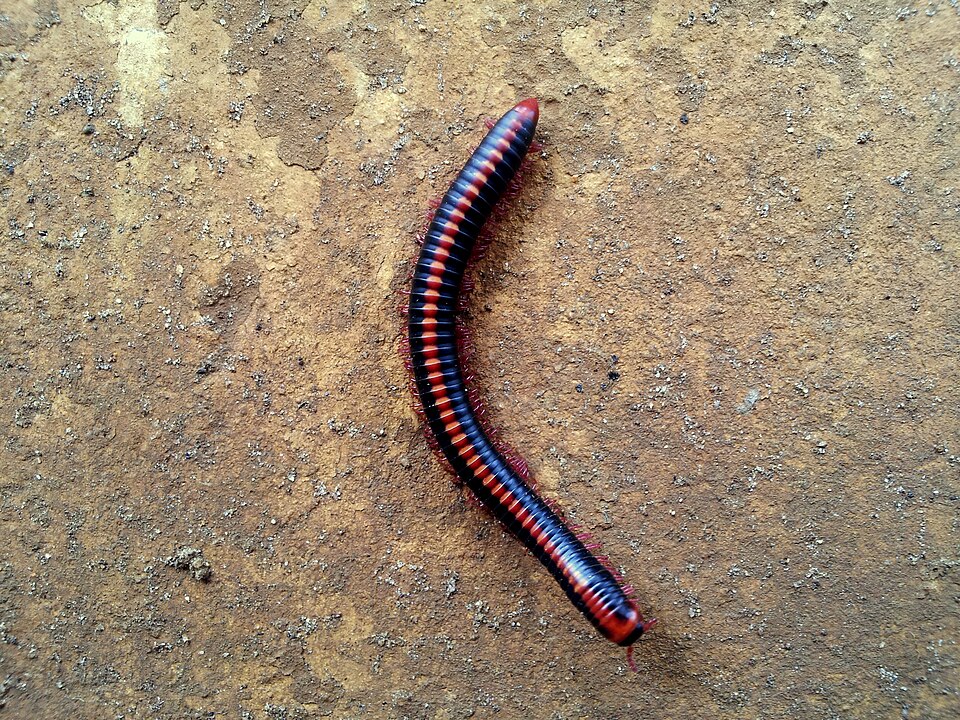
The red spined millipede is a long, dark millipede with a red or pink stripe running right down the middle of its back. Its body is made of about 50 rings. It is widespread in South India and Sri Lanka.
Fun fact: this one is not an insect. Insects have six legs, and this cousin has many, many more.
Lives in
South India and Sri Lanka
Length
5.8 to 6.5 cm (2.3 to 2.6 in)
Can it hurt you?
Harmless
Harmless. It does not bite or sting. Wash your hands after touching any millipede.
What does it eat?
Like other millipedes, it eats dead leaves and other rotting plant bits, and sometimes raids people's food.
How big is it?
How long is it?
🧱as long as 2 toy building bricks in a row🍽️could run across a dinner table in 14 seconds
How big is Red spined millipede compared to YOU?
Just maths in your browser. Nothing is saved or sent anywhere.
How fast is it?
A garden snail about 0.05 km/h (0.03 mph)
Red spined millipede about 0.25 km/h (0.16 mph)
A tortoise about 0.3 km/h (0.19 mph)
A person walking about 5 km/h (3.1 mph)
cool stuff
Fun facts
1
Its body has 48 to 50 segments.
2
It can become a nuisance in homes by damaging thatched roofs.
3
It sometimes gets into people's food and water supplies.
you asked
Most asked questions about Red spined millipede
?How long is the red spined millipede?
It is about 58 to 65 millimetres long.
?Is the red spined millipede dangerous?
No. It does not bite or sting, but it can be a pest in houses.
For bug experts
- Scientific name
- Xenobolus carnifex
- Group
- Centipedes and millipedes
- Classification
- Diplopoda > Spirobolida
- Lives on
- Asia
Where the facts come from
- Xenobolus carnifex (Wikipedia, CC BY-SA 4.0): what it looks like, where it lives, what it eats, sizes and fun facts, retold in simple words.
- Picture by Gihan Jayaweera. CC BY-SA 4.0, Wikimedia Commons. The sticker of this bug is drawn from this picture.
If we got something wrong, sorry, we are bug fans, not a science journal. Tell us at [email protected] and we will fix it.
Bug Wiki honey jar For grown-ups: Bug Wiki is free, with no ads and no tracking. A small tip helps keep it online.Leave a tip Giant African millipede
 House centipede
 Amazonian giant centipede
 Vietnamese centipede
 Giant desert centipede
 Greenhouse millipede
 Texas milkweed beetle
 Band-winged wingwaver
 Striped thistle longhorn beetle
 Dusky-blue groundstreak
 Alpine heath
 Hop-garden earwig