
Brazilian black-and-white tarantula
Nhandu coloratovillosus

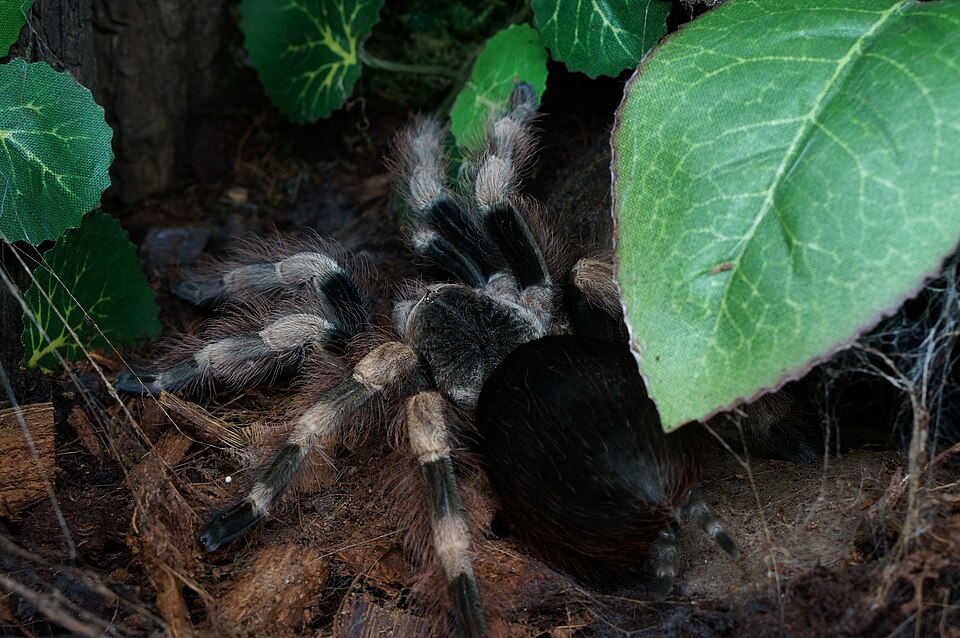
The Brazilian black-and-white tarantula is a big, hairy spider from South America. Its legs have black and white bands, and its body is covered in long orange hairs. It lives on the ground in wide grasslands.
Fun fact: spiders are not insects. Insects have six legs, spiders have eight. Everyone calls them bugs anyway!
Lives in
Brazil and Paraguay, in grasslands
What does it eat?
Like other tarantulas, it hunts insects and other small animals on the ground.
How fast is it?
A tortoise about 0.3 km/h (0.19 mph)
Brazilian black-and-white tarantula about 1.5 km/h (0.93 mph)
A person walking about 5 km/h (3.1 mph)
A kid running fast about 13 km/h (8.1 mph)
cool stuff
Fun facts
1
A female can live for 15 years. A male lives only up to about 4 years.
2
Its grassland home can be as hot as 35 degrees in summer and freezing in winter.
3
Every one has its own personality. Some are very calm, others are nervous and jumpy.
4
When it is scared, it rubs itchy hairs off its body towards the danger.
you asked
Most asked questions about Brazilian black-and-white tarantula
?How long does the Brazilian black-and-white tarantula live?
Females can live 15 years, males only about 4 years.
?Where does the Brazilian black-and-white tarantula live?
In the grasslands of Brazil and Paraguay, on the ground.
For bug experts
- Scientific name
- Nhandu coloratovillosus
- Named by
- Schmidt, 1998
- Group
- Spiders
- Family
- Theraphosidae
- Classification
- Arachnida > Araneae > Theraphosidae
- Lives on
- South America
- Also known as
- Bombardier tarantula, Brazilian black & white tarantula
Where the facts come from
- Nhandu coloratovillosus (Wikipedia, CC BY-SA 4.0): what it looks like, where it lives, what it eats, sizes and fun facts, retold in simple words.
- Picture by Sebastian Szmigielski. CC BY-SA 4.0, Wikimedia Commons. The sticker of this bug is drawn from this picture.
If we got something wrong, sorry, we are bug fans, not a science journal. Tell us at [email protected] and we will fix it.
Bug Wiki honey jar For grown-ups: Bug Wiki is free, with no ads and no tracking. A small tip helps keep it online.Leave a tip European garden spider
 Goliath birdeater
 Brown recluse
 Redback spider
 Yellow garden spider
 Bold jumping spider
 Death's-head hawk-moth
 Violet carpenter bee
 Large bee-fly
 Eastern yellowjacket
 Virginian tiger moth
 Large yellow underwing