

Bug card No. 0082 of 1,500
Australian paralysis tick
Ixodes holocyclus
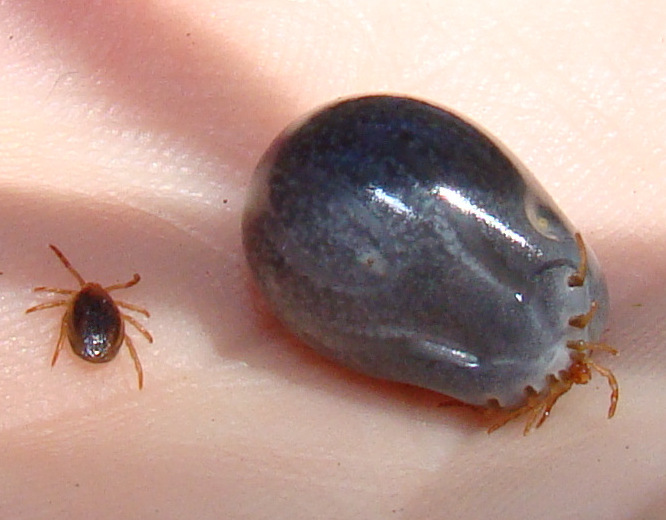
The Australian paralysis tick is a tiny tick that lives along the east coast of Australia. It climbs onto plants and waits with its front legs out to grab a passing animal. It drinks blood, and it is the most important tick in Australia to watch out for.
Fun fact: this one is not an insect. It is an arachnid with eight legs, a cousin of the spiders.
Lives in
A strip along the east coast of Australia, especially in wet forests and rainforests
What does it eat?
It drinks blood.
How fast is it?
Australian paralysis tick about 0.02 km/h (0.01 mph)
A garden snail about 0.05 km/h (0.03 mph)
A tortoise about 0.3 km/h (0.19 mph)
A person walking about 5 km/h (3.1 mph)
cool stuff
Fun facts
1
A baby tick hatches with only six legs. It gets two more legs later, when it grows into the next stage.
2
It needs three blood meals from three different animals to grow up.
3
A female can lay up to 3000 eggs in the fallen leaves.
you asked
Most asked questions about Australian paralysis tick
?Where does the paralysis tick live?
Along the east coast of Australia, mostly in wet forests.
?How many legs does a tick have?
Grown-up ticks have eight legs, like spiders. Baby ticks have only six.
For bug experts
- Scientific name
- Ixodes holocyclus
- Named by
- Neumann, 1899
- Group
- Scorpions, ticks and friends
- Family
- Ixodidae
- Classification
- Arachnida > Ixodida > Ixodidae
- Lives on
- Australia and Oceania
- Also known as
- Paralysis tick
Where the facts come from
- Ixodes holocyclus (Wikipedia, CC BY-SA 4.0): what it looks like, where it lives, what it eats, sizes and fun facts, retold in simple words.
- Picture by Bjørn Christian Tørrissen. CC BY-SA 3.0, Wikimedia Commons. The round sticker of this bug is cut from the same picture.
If we got something wrong, sorry, we are bug fans, not a science journal. Tell us at [email protected] and we will fix it.
 Emperor scorpion
 Lone star tick
 Deathstalker
 Itch mite
 Eyelash mite
 Deer tick
 Peppered moth
 Spicebush swallowtail
 New Zealand glowworm
 Yellow-spotted millipede
 Black carpenter ant
 Spitfire sawfly