

Brazilian red and white tarantula
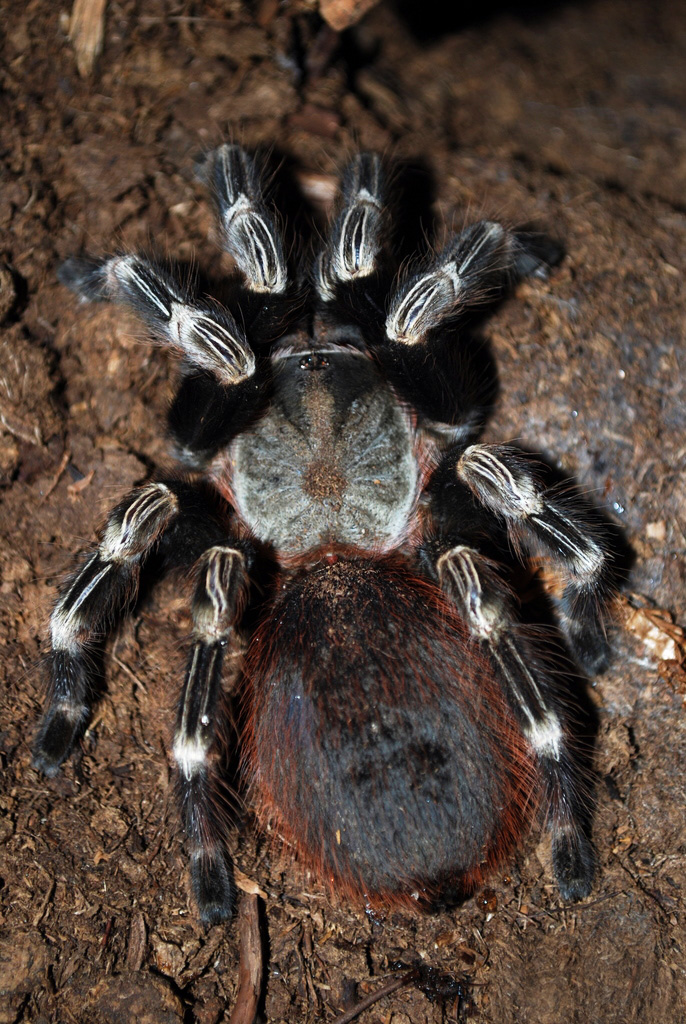
The Brazilian red and white tarantula is a big, hairy spider with white stripes on its legs and reddish hairs on its back. It lives on the ground and likes to hide in a burrow. Many spider fans love it for its pretty colours.
How fast is it?
Fun facts
With its legs spread out, it is about 15 to 17 centimetres across. That is bigger than a grown-up's hand.
It often moves into an empty burrow that another animal dug.
Boys and girls look the same until the boys have their last skin change. Then the boys get duller colours and longer legs.
Scientists moved it to another group of spiders in 2023 and then back again in 2026.
Most asked questions about Brazilian red and white tarantula
?How big does the Brazilian red and white tarantula get?
Its legs reach about 15 to 17 centimetres from one side to the other.
?Where does the Brazilian red and white tarantula live?
In Brazil, in tropical forests and savannahs, often in a burrow in the ground.
For bug experts
- Scientific name
- Nhandu chromatus
- Named by
- Schmidt, 2004
- Group
- Spiders
- Family
- Theraphosidae
- Classification
- Arachnida > Araneae > Theraphosidae
- Lives on
- South America
Where the facts come from
- Brazilian red and white tarantula (Wikipedia, CC BY-SA 4.0): what it looks like, where it lives, what it eats, sizes and fun facts, retold in simple words.
- Picture by Flamesbane. CC BY 3.0, Wikimedia Commons. The round sticker of this bug is cut from the same picture.
If we got something wrong, sorry, we are bug fans, not a science journal. Tell us at [email protected] and we will fix it.
 European garden spider
 Goliath birdeater
 Brown recluse
 Redback spider
 Yellow garden spider
 Bold jumping spider
 Asian marauder ant
 Madagascan sunset moth
 Greater banded hornet
 Lesser banded hornet
 Devil's flower mantis
 Comet moth