

Four-spotted chaser
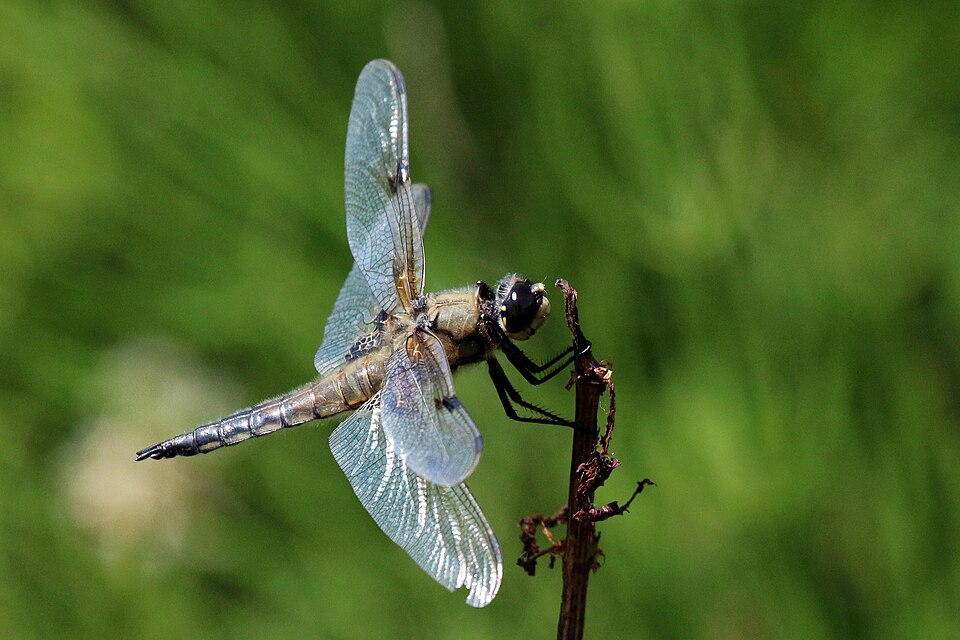
The four-spotted chaser is a brown dragonfly with a dark spot in the middle of each of its four wings. That is how it got its name. It zooms over ponds and slow rivers, catching little flying insects.
How fast is it?
Fun facts
It is the state insect of Alaska.
A boy guards his own patch of pond and chases other boys away.
It likes to sit on the same favourite perch again and again while it keeps watch.
Its babies live in the water for two years before they become dragonflies.
Bigger emperor dragonflies and green tiger beetles sometimes catch it.
Most asked questions about Four-spotted chaser
?What does the four-spotted chaser eat?
Mosquitoes, gnats and midges. Its babies eat water insects and tadpoles.
?Is the four-spotted chaser dangerous?
No. It has no sting and is harmless to people.
?When can you see a four-spotted chaser?
Mostly in early summer, in June and July.
For bug experts
- Scientific name
- Libellula quadrimaculata
- Group
- Dragonflies and damselflies
- Family
- Libellulidae
- Classification
- Insecta > Odonata > Libellulidae
- Lives on
- Europe, Asia, North America
- Also known as
- Four-spotted skimmer
Where the facts come from
- Four-spotted chaser (Wikipedia, CC BY-SA 4.0): what it looks like, where it lives, what it eats, sizes and fun facts, retold in simple words.
- Picture by Charles J. Sharp. CC BY-SA 4.0, Wikimedia Commons. The round sticker of this bug is cut from the same picture.
If we got something wrong, sorry, we are bug fans, not a science journal. Tell us at [email protected] and we will fix it.
 Emperor dragonfly
 Common whitetail
 Green darner
 Ebony jewelwing
 Globe skimmer
 Blue dasher
 Buzzer midge
 Summer fishfly
 Pennsylvania firefly
 Common pond skater
 Amber snail
 Large copper
_male.jpg)