
Green meshweaver

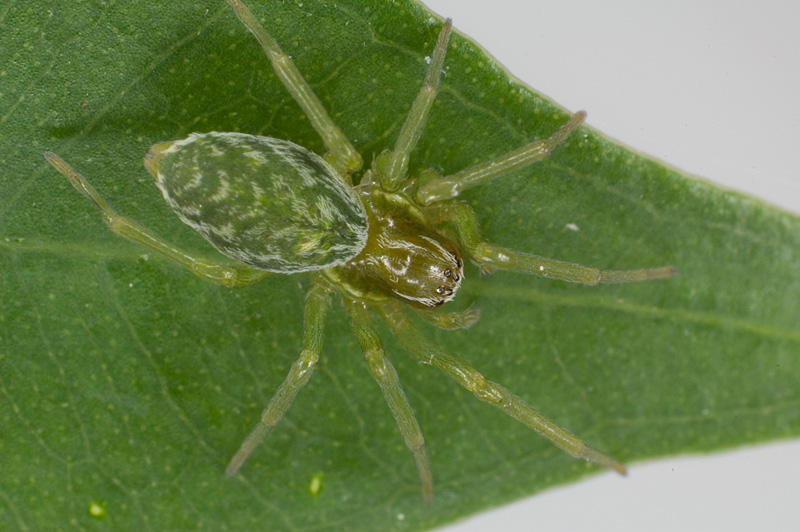
The green meshweaver is a tiny spider with a shiny green tummy. Its green colour makes it almost invisible on a leaf. It spins a little web right on the top of big leaves to catch insects.
How big is it?
How long is it?
How big is Green meshweaver compared to YOU?
Just maths in your browser. Nothing is saved or sent anywhere.
How fast is it?
Fun facts
It is at most 5 millimetres long, but it is still the biggest spider in its family.
Its egg sac is about 7 millimetres long, bigger than the spider itself.
The mother hides her egg sac far away from her own hiding place.
You can find it from August to October, often on lilac leaves.
In Britain it was only found around London for a long time. It may first have arrived at Kew Gardens.
Most asked questions about Green meshweaver
?Where can I find a green meshweaver?
On big leaves in gardens, like lilac or grapevine, from August to October.
For bug experts
- Scientific name
- Nigma walckenaeri
- Group
- Spiders
- Family
- Dictynidae
- Classification
- Arachnida > Araneae > Dictynidae
- Lives on
- Europe, Asia
Where the facts come from
- Nigma walckenaeri (Wikipedia, CC BY-SA 4.0): what it looks like, where it lives, what it eats, sizes and fun facts, retold in simple words.
- Picture by Michael Hohner ( Mhohner ). CC BY 3.0, Wikimedia Commons. The sticker of this bug is drawn from this picture.
If we got something wrong, sorry, we are bug fans, not a science journal. Tell us at [email protected] and we will fix it.
Bug Wiki honey jar For grown-ups: Bug Wiki is free, with no ads and no tracking. A small tip helps keep it online.Leave a tip European garden spider
 Goliath birdeater
 Brown recluse
 Redback spider
 Yellow garden spider
 Bold jumping spider
 Eason's geophilus
 Subvittate lady beetle
 Painted meadow grasshopper
 Elegant helicellid
 Valerian psyllid
 Wrinkle-winged calosoma