
House jumping spider
Pseudeuophrys lanigera
Name means: “wool-bearing”

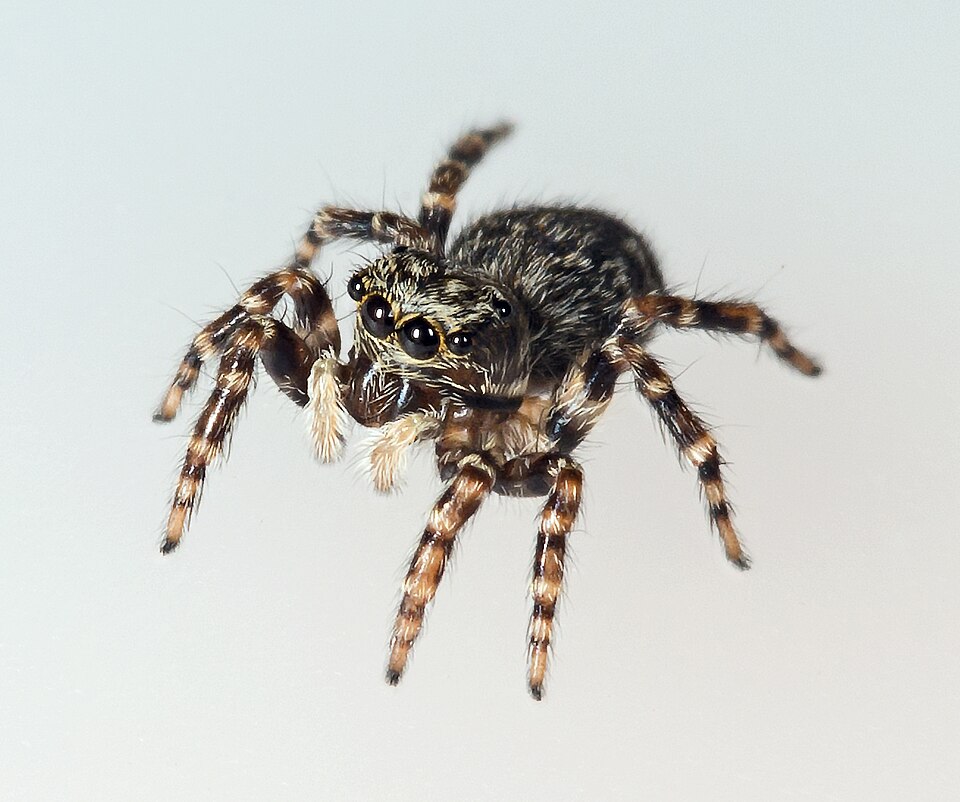
The house jumping spider is a tiny, woolly looking jumping spider that lives in and around houses. It is only a few millimetres long. You can find grown-up ones on walls even in the middle of winter.
Fun fact: spiders are not insects. Insects have six legs, spiders have eight. Everyone calls them bugs anyway!
Lives in
Western and southern Europe to the Caucasus, inside houses and on walls
Length
3 to 5 mm (0.12 to 0.2 in)
What does it eat?
It hunts tiny insects, such as booklice.
How big is it?
How long is it?
💅small enough to sit on your fingernail🍽️could run across a dinner table in 4.9 seconds⚡moves 41 times its own body length every second
How big is House jumping spider compared to YOU?
Just maths in your browser. Nothing is saved or sent anywhere.
How fast is it?
A garden snail about 0.05 km/h (0.03 mph)
A tortoise about 0.3 km/h (0.19 mph)
House jumping spider about 0.73 km/h (0.45 mph)
A person walking about 5 km/h (3.1 mph)
cool stuff
Fun facts
1
Its name lanigera means wool-bearing, because it looks fluffy.
2
It copes well with the dry air inside modern concrete buildings.
3
It first came to Germany in the 1950s and now lives there mostly in houses.
4
The girls can grow to about 5 millimetres, a bit bigger than the boys.
you asked
Most asked questions about House jumping spider
?Why is there a jumping spider in my house in winter?
This kind lives indoors, so the grown-ups can be found all year round, even in deep winter.
For bug experts
- Scientific name
- Pseudeuophrys lanigera
- Group
- Spiders
- Family
- Salticidae
- Classification
- Arachnida > Araneae > Salticidae
- Lives on
- Europe, Asia
Where the facts come from
- Pseudeuophrys lanigera (Wikipedia, CC BY-SA 4.0): what it looks like, where it lives, what it eats, sizes and fun facts, retold in simple words.
- Picture by Didier Descouens. CC BY-SA 4.0, Wikimedia Commons. The sticker of this bug is drawn from this picture.
If we got something wrong, sorry, we are bug fans, not a science journal. Tell us at [email protected] and we will fix it.
Bug Wiki honey jar For grown-ups: Bug Wiki is free, with no ads and no tracking. A small tip helps keep it online.Leave a tip European garden spider
 Goliath birdeater
 Brown recluse
 Redback spider
 Yellow garden spider
 Bold jumping spider
 Italian scorpion
 Thief ant
 Brown house moth
 Variegated paper wasp
 Four-lined silverfish
 Eastern bloodsucking conenose