

Bug card No. 0754 of 1,500
House pseudoscorpion
Chelifer cancroides
Eats: Other bugs and small animalsScorpions, ticks and friendsHouses and farms8 legsNot an insect, but a bug cousin
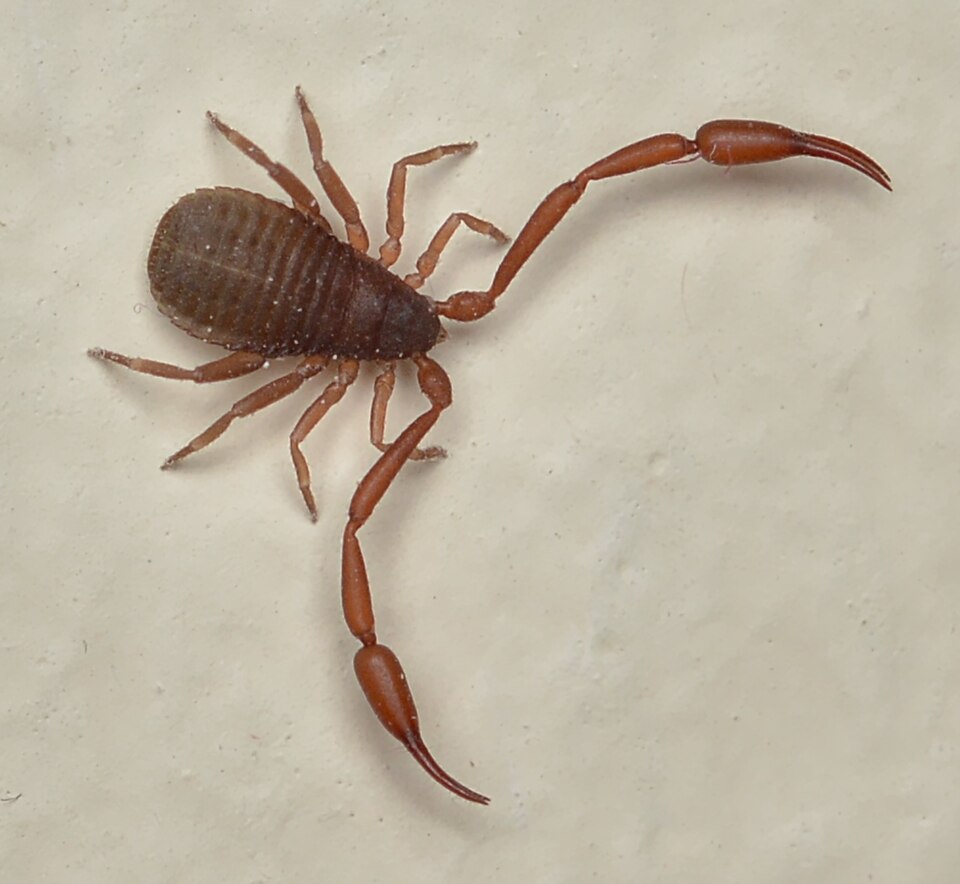
The house pseudoscorpion is a tiny reddish brown creature that looks like a scorpion without a tail. It has two long arms with pincers at the ends. It lives quietly in houses, barns and beehives and catches even tinier bugs.
Fun fact: this one is not an insect. It is an arachnid with eight legs, a cousin of the spiders.
Lives in
Almost all over the world, often in houses, barns, stables and beehives
Length
2.5 to 4.5 mm (0.1 to 0.18 in)
What does it eat?
It catches tiny animals like booklice, fruit flies and mites, including the mites that make honeybees sick.
How big is it?
How long is it?
💅small enough to sit on your fingernail🍽️could run across a dinner table in 6.5 seconds⚡moves 34 times its own body length every second
How big is House pseudoscorpion compared to YOU?
Just maths in your browser. Nothing is saved or sent anywhere.
How fast is it?
A garden snail about 0.05 km/h (0.03 mph)
A tortoise about 0.3 km/h (0.19 mph)
House pseudoscorpion about 0.55 km/h (0.34 mph)
A person walking about 5 km/h (3.1 mph)
cool stuff
Fun facts
1
Its pincer arms are about twice as long as its body.
2
It sometimes hitches a ride on flies, bees or even bats to travel to a new place.
3
In beehives it eats the mites that harm the bees, so it is a helper.
4
It usually lives three or four years, which is long for such a tiny creature.
you asked
Most asked questions about House pseudoscorpion
?What does a pseudoscorpion eat?
Tiny animals like booklice, fruit flies and mites.
For bug experts
- Scientific name
- Chelifer cancroides
- Named by
- Linnaeus, 1758
- Group
- Scorpions, ticks and friends
- Family
- Cheliferidae
- Classification
- Arachnida > Pseudoscorpiones > Cheliferidae
- Lives on
- Europe, North America, Africa, Australia and Oceania
Where the facts come from
- Chelifer cancroides (Wikipedia, CC BY-SA 4.0): what it looks like, where it lives, what it eats, sizes and fun facts, retold in simple words.
- Picture by Ryan Hodnett. CC BY-SA 4.0, Wikimedia Commons. The round sticker of this bug is cut from the same picture.
If we got something wrong, sorry, we are bug fans, not a science journal. Tell us at [email protected] and we will fix it.
 Emperor scorpion
 Lone star tick
 Deathstalker
 Itch mite
 Eyelash mite
 Deer tick
 Small hive beetle
 Southern house mosquito
 Indian stick insect
 Little black ant
 Lesser mealworm
 White-shouldered house moth