

Bug card No. 0774 of 1,500
Indian tiger centipede
Scolopendra hardwickei
Eats: Other bugs and small animalsCentipedes and millipedesRainforests and junglesNot an insect, but a bug cousin
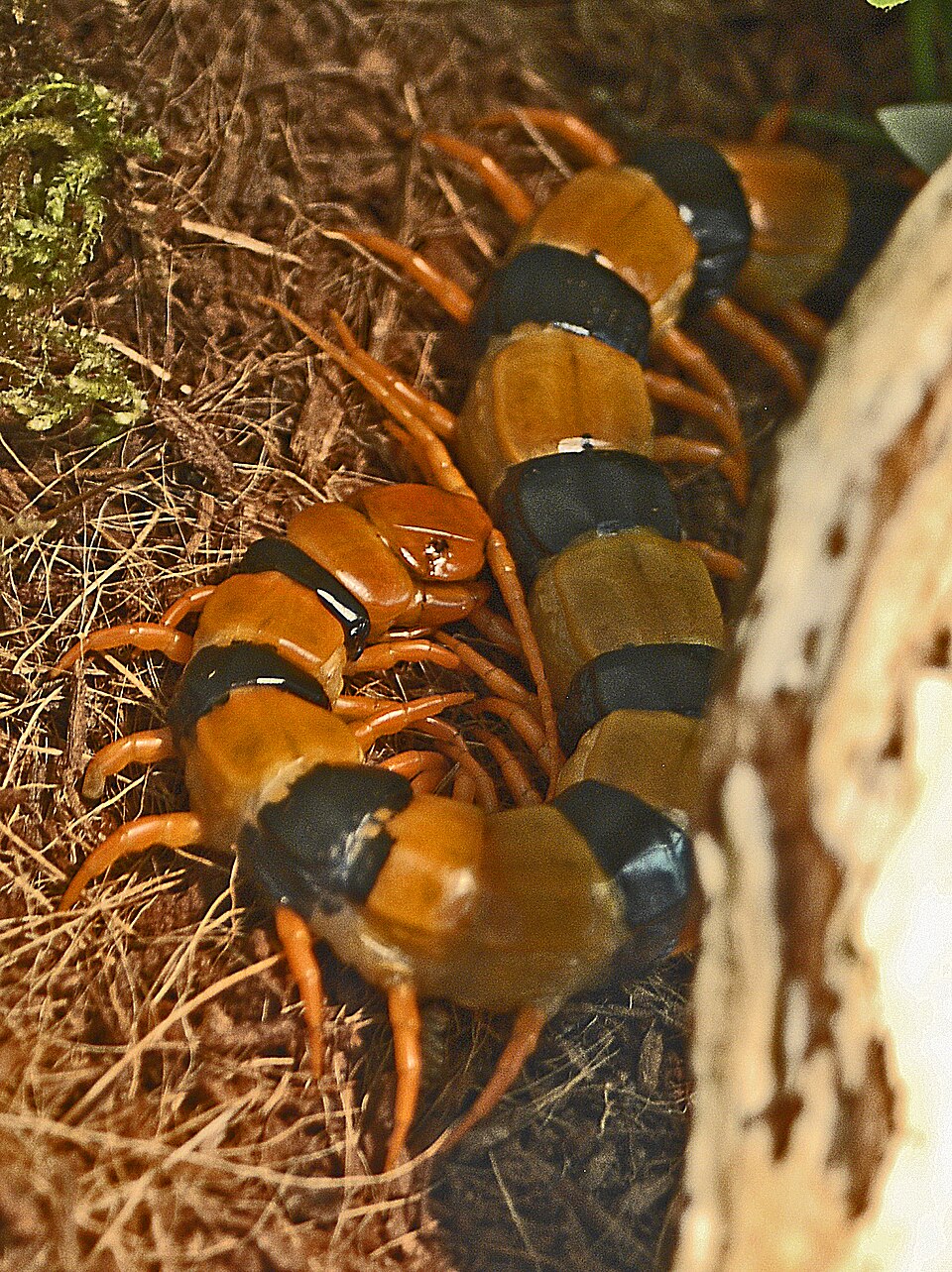
The Indian tiger centipede is one of the most colourful centipedes in the world. Its body has stripes of bright orange and deep black, just like a tiger. It is big too, as long as a pencil is to its tip.
Fun fact: this one is not an insect. Insects have six legs, and this cousin has many, many more.
Lives in
Southern India, and rarely on the islands of Sumatra and Nicobar
Length
16 cm (6.3 in)
the biggest onesWhat does it eat?
Like all centipedes, it is a hunter that catches other small animals.
How big is it?
How long is it?
🧱as long as 5 toy building bricks in a row✋about as long as your hand🍽️could run across a dinner table in 1 seconds
How big is Indian tiger centipede compared to YOU?
Just maths in your browser. Nothing is saved or sent anywhere.
How fast is it?
Indian tiger centipede about 3.5 km/h (2.2 mph)
A person walking about 5 km/h (3.1 mph)
A kid running fast about 13 km/h (8.1 mph)
A grown-up on a bike about 25 km/h (16 mph)
cool stuff
Fun facts
1
It can grow up to 16 centimetres long.
2
Even its legs, head and feelers are dark orange.
3
Each feeler has 17 or 18 little parts, and the first ones near the head are shiny.
you asked
Most asked questions about Indian tiger centipede
?How big is the Indian tiger centipede?
It can grow up to 16 centimetres long.
?Where does the Indian tiger centipede live?
Mostly in the south of India.
For bug experts
- Scientific name
- Scolopendra hardwickei
- Group
- Centipedes and millipedes
- Family
- Scolopendridae
- Classification
- Chilopoda > Scolopendromorpha > Scolopendridae
- Lives on
- Asia
Where the facts come from
- Scolopendra hardwickei (Wikipedia, CC BY-SA 4.0): what it looks like, where it lives, what it eats, sizes and fun facts, retold in simple words.
- Picture by Hectonichus. CC BY-SA 3.0, Wikimedia Commons. The round sticker of this bug is cut from the same picture.
If we got something wrong, sorry, we are bug fans, not a science journal. Tell us at [email protected] and we will fix it.
 Giant African millipede
 House centipede
 Amazonian giant centipede
 Vietnamese centipede
 Giant desert centipede
 Greenhouse millipede
 Giant northern termite
 Indian stingless bee
 Discoid cockroach
 Acacia ant
 Goliath birdwing
 Peppermint stick insect