

Bug card No. 0917 of 1,500
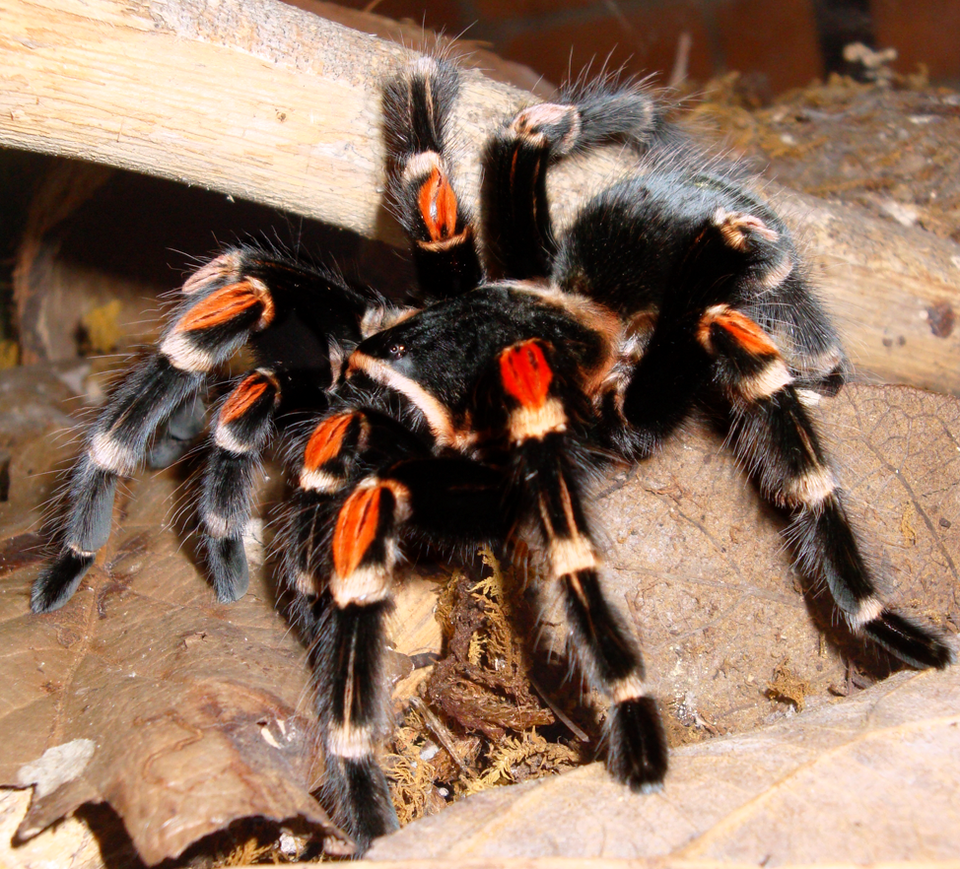
Mexican flame knee tarantula
Brachypelma auratum
Eats: Other bugs and small animalsSpidersDeserts and dry places8 legsNot an insect, but a bug cousin
The Mexican flame knee is a big, dark, hairy tarantula from Mexico. On each knee it has orange-red markings that look like little flames. That is how it got its name.
Fun fact: spiders are not insects. Insects have six legs, spiders have eight. Everyone calls them bugs anyway!
Lives in
Only in the Guerrero and Michoacán regions of Mexico
What does it eat?
Like other tarantulas, it hunts insects and other small animals.
How fast is it?
A tortoise about 0.3 km/h (0.19 mph)
Mexican flame knee tarantula about 1.5 km/h (0.93 mph)
A person walking about 5 km/h (3.1 mph)
A kid running fast about 13 km/h (8.1 mph)
cool stuff
Fun facts
1
It looks a lot like the famous Mexican redknee tarantula, but it is darker.
2
Because the two look so alike, scientists only named it as its own species in 1992.
3
It has been found sharing its home with a small frog.
4
It is protected, so catching and selling wild ones is limited by law, but some are still smuggled out of Mexico.
you asked
Most asked questions about Mexican flame knee tarantula
?Why is it called flame knee?
Because the orange-red markings on its knees look like flames.
?Where does the Mexican flame knee live?
Only in two regions of Mexico, Guerrero and Michoacán.
For bug experts
- Scientific name
- Brachypelma auratum
- Group
- Spiders
- Family
- Theraphosidae
- Classification
- Arachnida > Araneae > Theraphosidae
- Lives on
- North America
- Also known as
- Mexican flame knee
Where the facts come from
- Brachypelma auratum (Wikipedia, CC BY-SA 4.0): what it looks like, where it lives, what it eats, sizes and fun facts, retold in simple words.
- Picture by Ruben Kiel Alvarado. CC BY-SA 3.0, Wikimedia Commons. The round sticker of this bug is cut from the same picture.
If we got something wrong, sorry, we are bug fans, not a science journal. Tell us at [email protected] and we will fix it.
 European garden spider
 Goliath birdeater
 Brown recluse
 Redback spider
 Yellow garden spider
 Bold jumping spider
 Arabian fat-tailed scorpion
 Grey bird grasshopper
 Common yellow scorpion
 Transvaal thick-tailed scorpion
 European beewolf
 Desert millipede